
Decision Spread
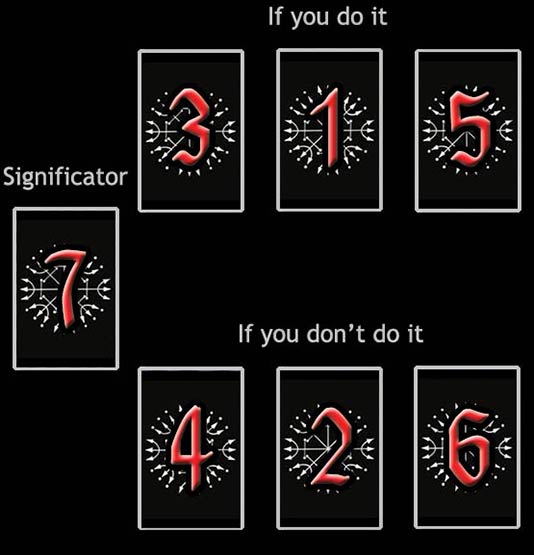
Difficulty: Easy
This simple but highly useful spread calls for a question to be asked in this format:
'What happens if I do (X), and what happens if I do not do (X)?'
Please note that it should not be viewed as a decision between two different options, but about whether a single option should be exercised or not. A second option would call for a separate reading.
Card #7 is the significator, the overall theme of the query.
Cards #3, #1, & #5 represent the chronological sequence of events that occurs if the reader chooses to do (X).
Cards #4, #2, & #6 represent the chronological sequence of events that unfolds if the reader chooses not to do (X).
Your Decision Reading
The Significator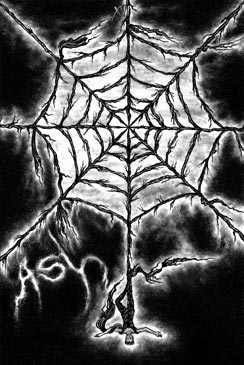 The Hanged One |
Outcome if you do it: | ||
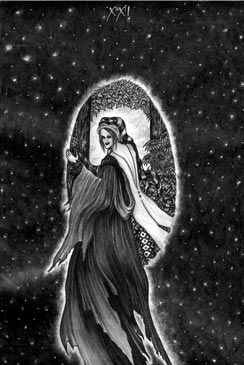 The World |
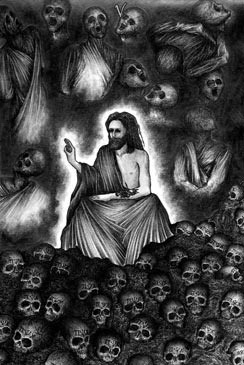 The Soothsayer |
 Death |
|
| Outcome if you don't do it: | |||
 The Emperor |
 5 of Hearts |
 The Star |
|
The Hanged One
This Hanged One is suspended in limbo but it is not a decision that is made in haste. This card suggests a stage where decisions are made based on unconditional sacrifice; without expectations of anything in return.
The seeker as The Hanged One may allow us to make choices that require some form of sacrifice; but they are made without conditions attached thus, it is an opportunity for growth and maturity.
The situation as The Hanged One suggests not making decisions in haste. If the outcome of any given situation depends on choices that we make; we may wish to reflect on how our contributions can and will influence the circumstances before making a move.
Outcome if you do it:
The World
From the Fool, we have come a full circle. What is there left to do but start over?
With a song in her heart and a prayer upon her lips, she steps out of the abyss into the World.
The Soothsayer
The Soothsayer represents the concept of conformity; both secular and spiritual. It is a stage of learning socially acceptable behaviour and ideals.
As the seeker, the Soothsayer suggests a time of reflection, based on what is expected of us and if those expectations coincide with our own.
As a situation, the Soothsayer indicates a phase of learning as well as understanding the environment one is in; and adapting to it without losing oneself in the name of conformity.
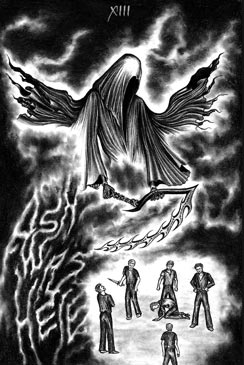
Death
There will come a time when all things end; a death that leaves one gasping for hope; fighting to cling on; afraid to let go. There will come a time when dreams of happy endings are rudely awakened by reality; wisps of wishful thinking disappearing into smoke; gone without a trace. There will come a time when the human heart breaks under such punishment; giving way to grief; dying bit by bit until it beats no more.
As a seeker, this card suggests a stage where one needs to learn to accept death as part of a natural cycle of life; deal with processes of letting things go; the need to move on.
As a situation, this card denotes an ending; thus, we may need to ask ourselves if holding on to something or someone may be detrimental to our growth. The time to let go will come when we acknowledge the need to do so.
Outcome if you do not do it:
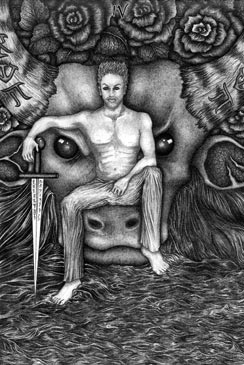
The Emperor
The Emperor card represents structure; the need for it or lack of it. It is about setting standards to adhere to, limitations and boundaries of rules of engagement and maintaining them. At a stage when one cannot identify such boundaries, The Emperor provides an idealised example until rigid adherence becomes a burden of expectations.
As the Seeker, this card represents the need to identify standards that are meaningful rather than those imposed by others. To discard old boundaries or limitations for new ones is a stage of self-regulation by which one identifies the principles to live by.
In a situation, this card suggests that stability may be achieved when a sound structure is in place.
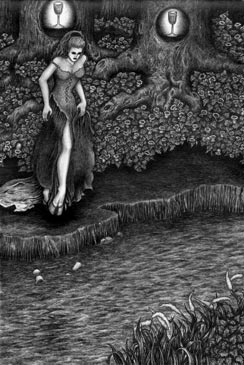
5 of Hearts
Uncertainty when faced with something that cannot be perceived with full clarity. The need to either take the risk or to look for other alternatives, otherwise there is real risk no progress at all can be made. Tentative steps towards taking a look at the face or façade you may have portrayed to yourself or others, understanding what is seen may lead to discomfort or a change in outlook.
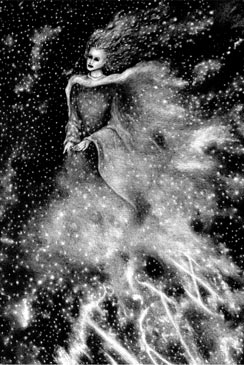
The Star
The Star shows the process of formation or disintegration of a nebula. The light from this process takes millions of light years to reach our galaxy millions of years so it is not "the present" moment as we see it. The Star card in The Diary suggests that all tangible things are subject to a cycle of creation that moves at its own pace and direction.
As the seeker, this card indicates that there are aspirations that are yet to be met or have already been fulfilled and it is time to either create the energy necessary for its formation; or allow it to disperse if the creation process is completed. Wishes are thoughts that are formed in the consciousness and it is up to the seeker to manifest it; or allow it to dissipate if it has already run its course.
As a situation, this card suggests a time of evaluating what is required to bring about the reality one wishes to create in one's future that is eventually to form a destiny. It may also suggest that dreams are the seed that requires one's effort to manifest into reality provided the steps are taken to ensure its growth. Without first identifying the situation one wishes to create, the possibility dissipates into unfulfilled aspirations.