
The Love Triangle Spread
Difficulty: Complicated
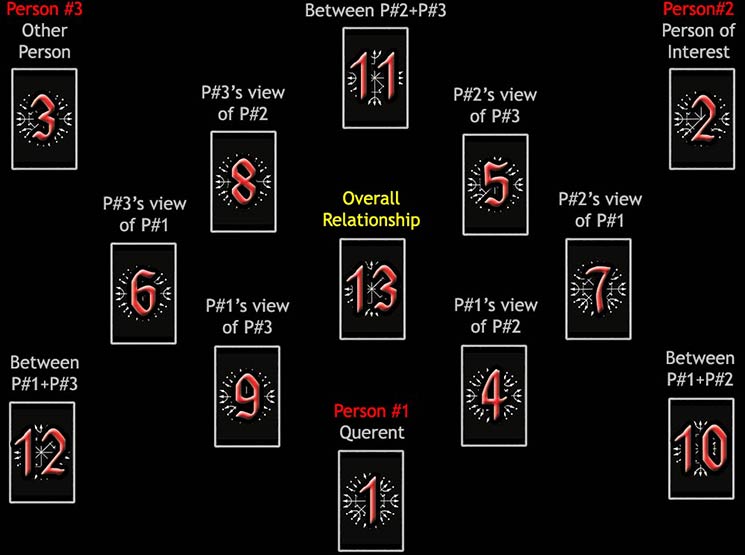
Casually referred to as the Love Triangle, this spread can be used to determine the dynamics of the relationship between three people, regardless of whether romance is involved. This spread is arranged in the form of a hexagram, consisting of several large and small triangles. This tarot spread may seem somewhat complicated, but it is not entirely that difficult.
The first step is to interpret the card for each individual position in the spread. Generally, one might ask about a relationship they are involved in, but this does not have to be the case. Ordinarily, the reader's representative card is #1, their main person of interest is #2, and the other person would be #3.
The second step fills in the downward triangle and involves further examination of the individuals through their views of the other people. Each person has two more cards showing the way they see and relate to the other members of the triangle. For example, Card #6 indicates how Person #3 relates to Person #1, while Card #9 stands for Person #1's attitude toward Person #3.
The next step completes the upward triangle and the hexagram, focusing on cards #10–13. It also completes the many smaller triangles and hints at the potential for each relationship. The final card, #13 can be considered the significator of the reading, which suggests the overall potential for this three-way relationship.
Your Love Triangle Reading
| P#3 | 3to2 | 2+3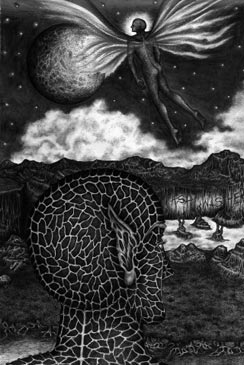 |
2to3 | P#2 | ||
 |
3to1 | 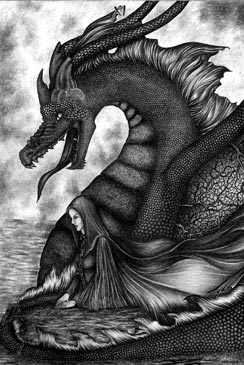 |
Overall | 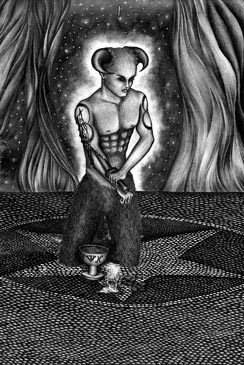 |
2to1 | 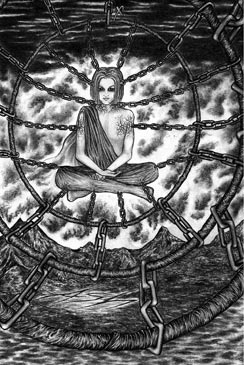 |
| 1+3 | 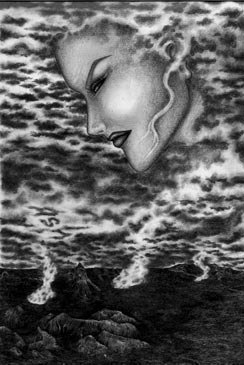 |
1to3 | 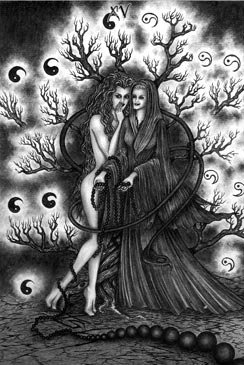 |
1to2 | 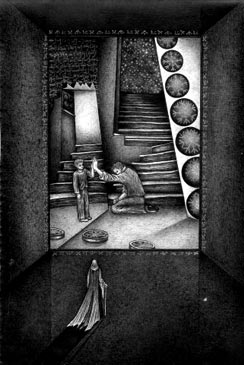 |
1+2 |
 |
 |
P#1 | 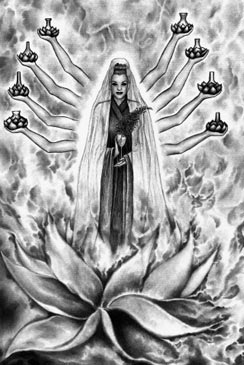 |
 |
||
 |
1: Person #1
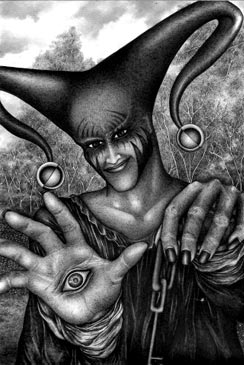
Dishonest communication, or lack of respect for how words can be twisted and be taken out of context. A requirement to see through the façade being presented in order to get to the real truth of a matter. Failure to understand the seriousness of a given situation. Seeing the funny side of a situation thus lessening the impact it may have on us otherwise. The not giving or receiving of a direct or straight-forward answer.
2: Person #2
Imprisoned Instincts is traditionally known as the Wheel of Fortune card in tarot. While it denotes sudden change for better or worse, nothing in life happens overnight. Sometimes, we are aware of signs of change and address them or we may overlook them and pay for consequences later.
As the seeker, this card indicates that methods of coping to circumstance surrounding us contribute to what happens in the future. Thus, taking responsibility for decisions we make empower us to create the future we wish for ourselves. Taking action is a choice; doing nothing to change our circumstances is also a choice.
As a situation, Imprisoned Instincts suggest a change and while the circumstances may be out of our control but how we deal with what happened/happens is. Perhaps it is time to assess at personal methods of coping and not the event itself.
3: Person #3
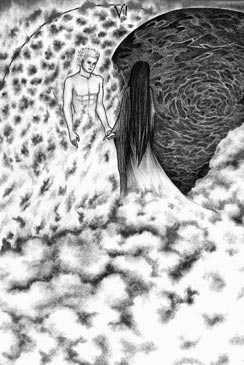
The Lovers card is a stage related to choice and decision-making. It represents how people of influence in our lives effect our choices, thus, it is a card that is also related to interpersonal relationships.
As the seeker, The Lovers card indicates a pivotal stage where the Seeker is faced with options but the challenge lies not in making the "Right" or "Wrong" decision. Rather is a reminder that the easy way out may not necessarily lead to a long-term solution.
As a situation, The Lovers card suggests weighing options not for hedonistic gain but long-term consequences.
4: Person #1's view of #2
Personal nurturing whereby the true spirit has the chance to emerge and subsequently flourish. Replacing of negative thoughts and emotions of the self with more positive ones. Understanding that love of the self is more important than the love that is offered to another. Having confidence in showing to the world and those around you your emotional self as well as your physical self.
5: Person #2's view of #3
The Magician card indicates an initiation; it is a beginning in the process of creation. The tools are laid out; The Magician is not lacking in skill but in experience thus, the method used may be questionable. It is a stage of self-mastery and success will depend on how The Magician utilises both skill and tools laid out before him.
In a situation, The Magician card suggests a stage of active involvement and the need to evaluate options before making decisions.
6: Person #3's view of #1
Doing what is needed to pave the way for a new beginning or regrowth regardless of how long it may take to manifest. Honest communication or wise counsel. Observing others allowing them to learn by their own mistakes before offering guidance as to how the lesson can pave the way for future endeavours. Knowing when silence is the most appropriate way of dealing with another person or issue and when to be to the point verbally. This could indicate a person who will be honest in their communication with themselves as well as others, impervious to the fact they may at times appear insensitive.
7: Person #2's view of #1
If the main focus is the elderly gentleman there could be an indication of taking an objective view of previous actions or relationships. If the main focus is the kneeling figure, it could show there is a pull to hang onto childhood or anything represented by childhood. Alternatively, it could show the turning of a back on material gains with an acknowledgement that friends and family are more important. If the main focal point is the child itself, it may indicate innocence and childhood are about to be left behind, but with no fear being shown in relation to the forthcoming changes.
8: Person #3's view of #2
The Strength card may suggest imposing one's will upon another whether intentional or not. It is a stage where we learn that true strength lies not in our ability to control what is in our external reality; rather it is about enduring hardships with grace and maintaining compassion.
The seeker as Strength advises us to explore aspects within that drives us to manipulate, control or influence people or situations without consideration. It may be an indication for us to realise that true strength lies not in exerting our will through force.
The situation as Strength may suggest a stage to evaluate the circumstances with objectivity. To maintain our position without compromise; if we perceive retreat as a weakness instead of strength.
9: Person #1's view of #3
New challenges which require movement, effort, energy or focus. A possible choice of aiming higher or reaching out sideways/laterally in our endeavours. Hesitancy or lack of confidence in moving away from what is seen as a comfort zone or position of safety.
10: Overall relationship between persons #1 and #2
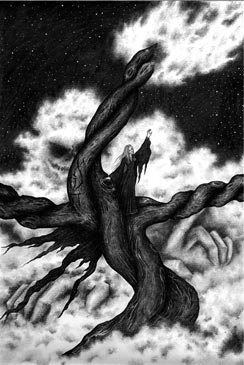
By nature a tendency to be impetuous or to be easily distracted. The characteristic of acting first and thinking later. A tendency to not think through repercussions of actions. A person who may not feel any sense of fear, and will tackle any task with vigour and enthusiasm.
11: Overall relationship between persons #2 and #3
Leaving behind of constraints, or the use of our spiritual wings to soar higher. The confidence to stretch ourselves and reach higher than we thought was initially achievable. The keeping of our feet on the earth, where we focus on what is within reach as opposed to trying for something that is possibly beyond our means. Can also indicate not wanting to extend our abilities through fear of being met with failure.
12: Overall relationship between persons #1 and #3
Being met with choices or options although there is no clear indication as to which alternative will prove to be the most beneficial. Offering of a choice to another but without giving due guidance as to repercussions of each on offer. Insight may be the key to success. Being wary of what is on offer, questioning the motives behind what is being presented.
13: Overall 3-way Relationship
The Devil is a whisper that comes from the depths of our heart; for what is temptation but a weakness most exploited by our desire.
As the seeker, The Devil suggests an attachment that has become unhealthy; therefore, we may need to explore what it is we have bound ourselves to and what that object of our desire represents to us before we are able to free ourselves from it.
As a situation, The Devil card advices us to be aware of becoming too involved; to the extent we are unable to perceive the situation clearly. As such, we may need to ask ourselves if decisions made are based on instant gratification or out of necessity.