Ankh Spread
Difficulty: Kind of tough
The Ankh Spread is for questions about the causes behind trends. It is similar to the Celtic Cross and Secret of the High Priestess spreads, but it covers the reasons behind the circumstances in question differently, perhaps giving a better explanation of why things are the way they are.
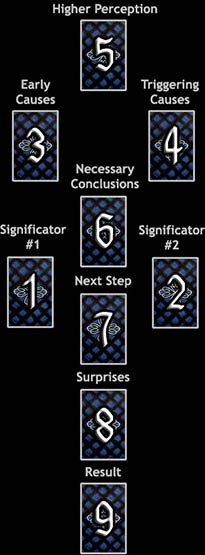
The loop of the upper section of the ankh reveals the spiritual background and causes of the situation, while the stem of the base focuses on prospects for the outcome.
The first two tarot cards represent the two parent causes of the situation. They will either complement each other or show two opposing sides of a conflict, depending on how they relate. These are the significator cards of the Ankh spread.
3. This tarot card shines light upon the early causes of the trend in question.
4. Pinpoints the causes that triggered the current situation.
5. Reveals the spiritual perspective of the subject at hand.
6. This card examines the reasons why this course of action had to unfold, as a means to this end.
At this point, it is good to pause to soak in the meaning of the first six cards before moving forward to the last three cards. The last three reveal prospects for the future.
7. The Next Step gives clues about the immediate future.
8. Surprising Experiences encountered en route to the result.
9. This represents the result.
Your Ankh Reading
| Early Causes | Higher Perceptions 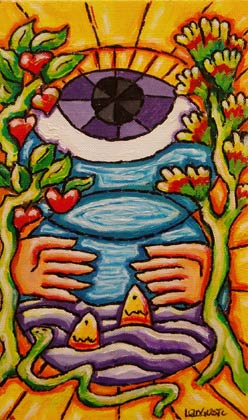 The Lovers |
Triggering Causes |
 The Empress |
Necessary Conclusions | 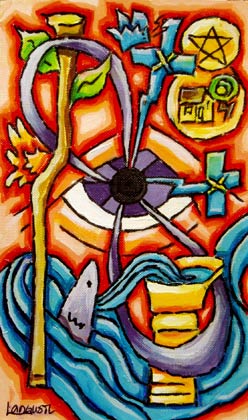 The Magician |
| Significator #1 | 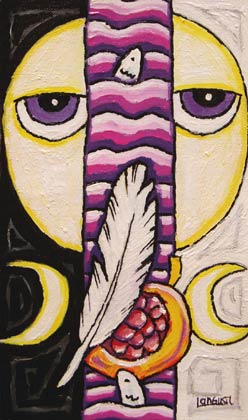 The High Priestess |
Significator #2 |
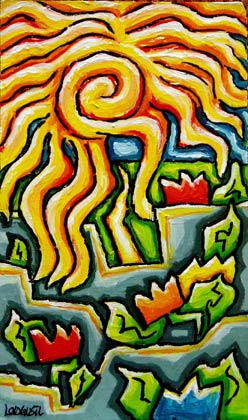 The Sun |
Next Step | 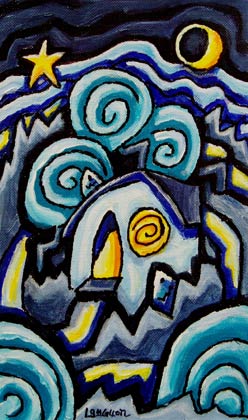 The Hermit |
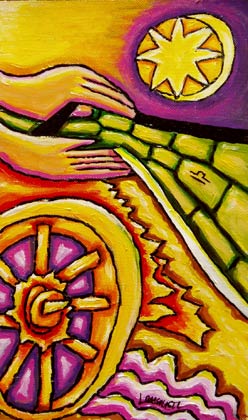 The Chariot |
||
Surprising Experiences 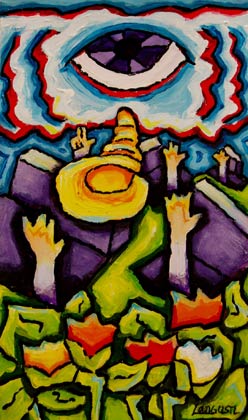 Judgement |
||
Outcome 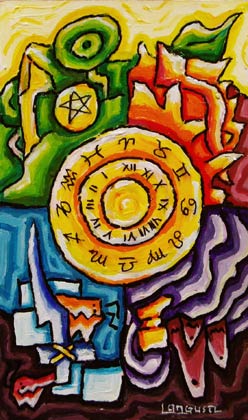 The Wheel of Fortune |
Significator #1
The Sun
The sun can be seen clearly and it dominates the picture. The last walls are being conquered and in between them flowers are already growing. This lets us suspect that the difficult path is at an end. The path, which continues, can already be seen beyond the wall.
Significator #2
The Hermit
The picture is kept fairly dark. The only light can be found in the star and the house. The moon, which does not shine itself, shows the occupation with the subconscious and the concealed which have to be discovered. The star shines itself, but is still too far away. It is the star the Hermit will follow as soon as he leaves the house. It is five-pointed, which forms a connection with the Hierophant's theme.
The picture's spirals in the trees, path and window turn in different directions and refer to the inward course. This can be consciously taken, turning to the right, or intuitively, turning to the left. The Hermit finds his light in the safety of the house. The fish (newly discovered emotions) are waiting outside for him. The direction of the path, which again follows outwardly, is not clearly evident. One can suspect strong emotions in the background, portrayed by moving water.
Early Causes
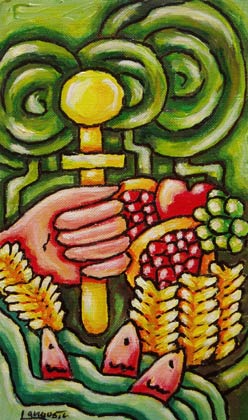
The Empress
The illustration represents growth, nature and fertility. One can see certain fruits, including two pomegranates (fertility). The ears of corn represent the Empress' secret crown. The apple is in the shape of a heart. The three fish in the water symbolise feelings and emotionalism, as well as the Empress' figure three.
The illusion of a bowl, in which the fruit is lying, can be connected with conception, the uterus and with pregnancy. The trees present slow growth. The Empress is holding her sceptre in her left hand.
Triggering Causes
The Magician
The symbols of all the elements are shown on the picture as possibilities. The eye, with its triangular shape, refers to the Holy Trinity. It seems as though it has just opened and one can recognise the spokes of the Wheel of Fortune in its iris.
The ribbon of eternity shows us how all possibilities can develop in waves out of the one item. The red background supports the energy of the illustration.
Higher Perceptions
The Lovers
The picture shows the connection with the opposite theme represented by two circles (blue = conscious) which combine to form an oval. The oval represents striving for unity on a higher level. The two hands stand for polarity and the confrontation with the tree of eternity and the tree of knowledge (of good and evil) with heart-shaped fruit. The serpent is coiled up at the foot of the tree of knowledge.
The yellow background emphasises the energy of the moment. Fish and water show the duality again and the produced flow of energy. The archangel Raphael watches over everyone with his blessing, indicated by God's eye.
Necessary Conclusions
The High Priestess
The two eyes indicate that the High Priestess perceives the polarity in their dualism but doesn't take any valuation into account. The light and the dark side can be seen, as well as the waning and waxing moon and the full-moon, which unites and contains both sides.
The water and the two fish also symbolise the connection, the flow of energy and the dualism. The feather stands for the High Priestess' sensitiveness, the pomegranate for her fertility.
The Next Step
The Chariot
The chariot itself is portrayed by the wheel. It has eight spokes, a symbol for the process of development. The shaft symbolises the centre and also the number nine, which completes the cycle. Hub and shaft are on fire and stand for sexual energy. Origin, the wheel's background, and destination, the celestial body's background, are the same colour, violet, which stands for the spiritual.
The dominating yellow in the picture depicts joy of living. The water at the bottom indicates frankness or naivety, but also emotions to be conquered, such as caution or fear. Black and white reins, held in the right and left hand, show different directions and ambivalences, which have to be brought into harmony to make the journey possible. The next part of the journey, which lies ahead of the coach driver, the material world, represented by green, square fields, opens up within all this.
Libra's symbol (justice) shows that one has to reckon with consequences for any mistakes. The section at the top leads into the night. The coach driver does not encounter the sun, as to be expected, but instead the moon and stars. He will meet intuition and the unconscious.
Surprises
Judgement
Classical symbols are also used here. Five graves are opening up, out of which stretches a hand to awaken a new life. The implication of the archangel Gabriel is blowing the trumpet of the Resurrection. One of the hands shows three fingers, which portrays a release from the grave's number four. It is also a gesture of the Hierophant.
The number five, shown by the number of hands and flowers, points to entirety. The aim is to see material things as being divine, so as to unite them and not to damn them and so create a new division. The flowers are about to bloom and through their colours the subjects of integration and entirety are emphasised again.
The Outcome
The Wheel of Fortune
In the middle of the diagram three discs can be seen. I often use the number three in the descriptions as a basic universal number. The inner disc is blank. On the second disc we can make out the hourly Roman numerals. They appear anticlockwise to show that time's direction is relative.
The signs of the zodiac on the outer disc show a further meaning for the course of time. Around these discs or rings, as though one could present them how one liked, the four elements are arranged. They seem to be rotating and moving in a circle from light into dark and back again.