Decision Spread
Difficulty: Easy
This simple but highly useful spread calls for a question to be asked in this format:
'What happens if I do (X), and what happens if I do not do (X)?'
Please note that it should not be viewed as a decision between two different options, but about whether a single option should be exercised or not. A second option would call for a separate reading.
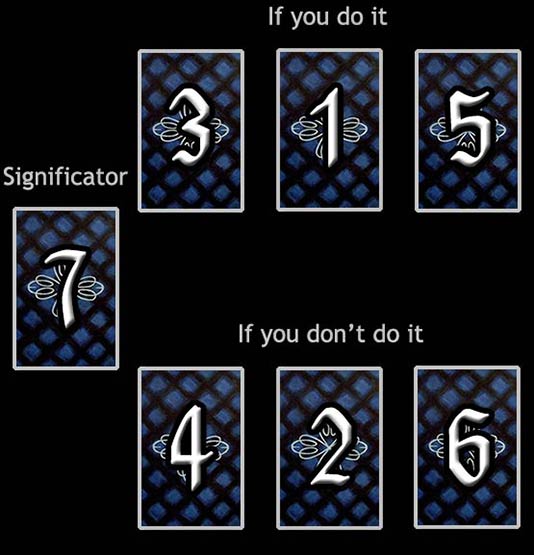
Card #7 is the significator, the overall theme of the query.
Cards #3, #1, & #5 represent the chronological sequence of events that occurs if the reader chooses to do (X).
Cards #4, #2, & #6 represent the chronological sequence of events that unfolds if the reader chooses not to do (X).
Your Decision Reading
The Significator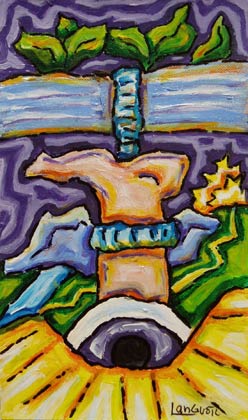 The Hanged Man |
Outcome if you do it: | ||
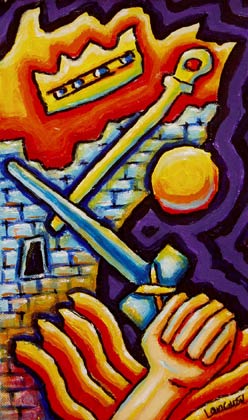 The Tower |
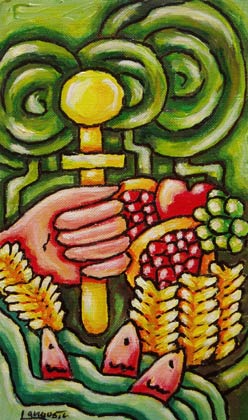 The Empress |
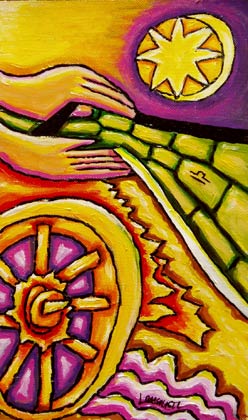 The Chariot |
|
| Outcome if you don't do it: | |||
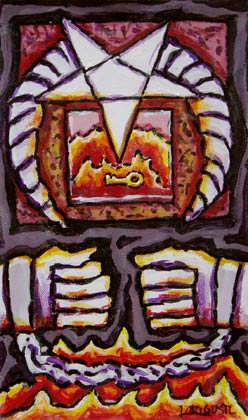 The Devil |
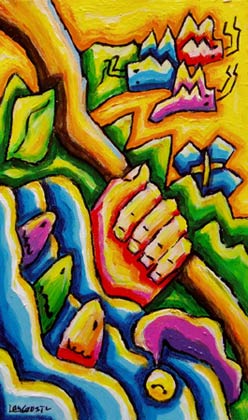 The Fool |
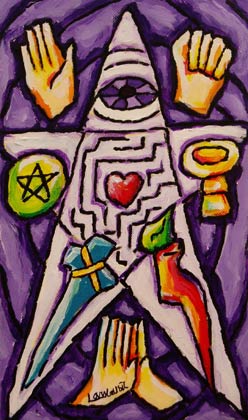 The Hierophant |
|
The Hanged Man
The sole of the foot is turned upwards, the world is turned upside down. This is what the picture shows. The beam and the rope are blue. Rationality, an attempt to consciously act, binds the hanged man. But here there also seems to be hope. Leaves are growing out of wood.
The colour yellow at the bottom of the picture stands for the light which the hanged man experiences when he manages to let himself fall. The wide path in the background leads to a dead-end against blue rocks. Walking back a bit one can find a narrow track which leads around the rocks back into the light. The violet background portrays the night sky. Normal vision is not carried any further.
Outcome if you do it:
The Tower
A small ray of light shines through a crack in the wall and arouses our yearning for freedom and knowledge. The prison walls burst open and we can escape. We have already taken hold of the sword which stands for differentiation, consciousness and independent thought.
The monarch's insignia of the Emperor shows we are prepared to reconquer the seat on our own throne.
The Empress
The illustration represents growth, nature and fertility. One can see certain fruits, including two pomegranates (fertility). The ears of corn represent the Empress' secret crown. The apple is in the shape of a heart. The three fish in the water symbolise feelings and emotionalism, as well as the Empress' figure three.
The illusion of a bowl, in which the fruit is lying, can be connected with conception, the uterus and with pregnancy. The trees present slow growth. The Empress is holding her sceptre in her left hand.
The Chariot
The chariot itself is portrayed by the wheel. It has eight spokes, a symbol for the process of development. The shaft symbolises the centre and also the number nine, which completes the cycle. Hub and shaft are on fire and stand for sexual energy. Origin, the wheel's background, and destination, the celestial body's background, are the same colour, violet, which stands for the spiritual.
The dominating yellow in the picture depicts joy of living. The water at the bottom indicates frankness or naivety, but also emotions to be conquered, such as caution or fear. Black and white reins, held in the right and left hand, show different directions and ambivalences, which have to be brought into harmony to make the journey possible. The next part of the journey, which lies ahead of the coach driver, the material world, represented by green, square fields, opens up within all this.
Libra's symbol (justice) shows that one has to reckon with consequences for any mistakes. The section at the top leads into the night. The coach driver does not encounter the sun, as to be expected, but instead the moon and stars. He will meet intuition and the unconscious.
Outcome if you do not do it:
The Devil
The colours black and white show the limits of a polarity, a disconnection, which cannot be outdone. The subconscious has no connection with the conscious. The burning fire points to the fact that the devil is linked with pain and torture.
The five-pointed star is upside down. The goat's horns are pointing downwards; classical symbols of the devil. The square oven symbolises the dependence on material things. Two clenched fists are chained together. Each can free the other whereby freeing itself, but only if it is brave enough to take the key from the fire. For this it has to open its hand.
The Fool
The bright colours symbolise many possibilities. The Fool is holding the pilgrim's staff in his hand. Water and fish indicate openness and vivacity. The butterflies also indicate different ideas and a joy of living.
The golden yellow background gives the scene energy of life. One can see the tip of the Fool's cap. The cross, or rather the handle of the sword in the background, gives an awareness of danger, which is lurking along the path the Fool is going to take.
The Hierophant
The pentahedral star in the picture shows how the four elements, which appear in the four lower rays, come into contact with spiritualism. This is represented in the uppermost point by God's eye, in the iris of which the Wheel of Fortune is alluded to. The violet background underlines the principle of spiritualism.
The labyrinth in the middle of the star points to the search for the meaning, which by way of the heart is also a search for the centre. The two hands at the top represent the obvious (exoteric) and the concealed (esoteric). The praying hands at the bottom symbolise the pupil.