Horse Shoe Spread
Difficulty: Easy
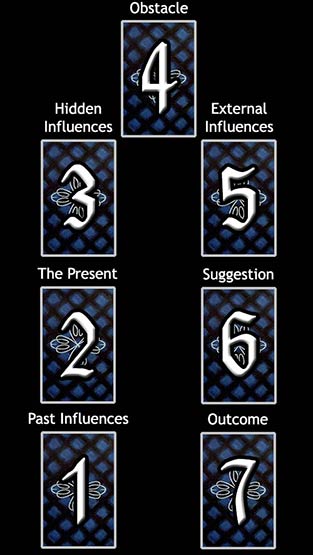
The Horse Shoe is a classic tarot spread. It is more advanced than the three-card reading, yet simpler than most other spreads. It is a versatile method that can be used for most queries, though there are other spreads which would go into more depth. Like the simple Past, Present, and Future spread, it contains these cards in positions #1, #2, and #7, but also has four other tarot cards that help the reader understand how to deal with the future better. The cards are to be read as follows:
- The Past: Past events affecting the question.
- The Present: The current state or approaching influence.
- Hidden Influences: Things the reader may not be aware of (or barely be aware of).
- Obstacles: This is the challenge: obstacles may be avoided or may have to be dealt with.
- External Influences: Attitudes and thoughts regarding people around the reader.
- Suggestions: Recommended course of action.
- Outcome: The result of following the suggestions.
Your Horse Shoe Reading
Obstacle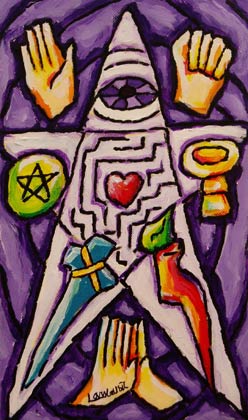 The Hierophant |
||
Hidden Influences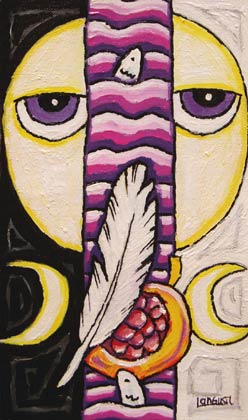 The High Priestess |
External Influences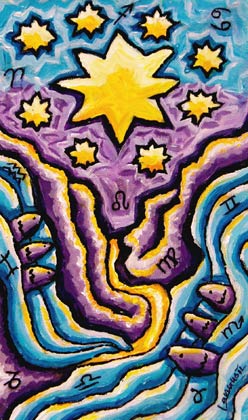 The Star |
|
The Present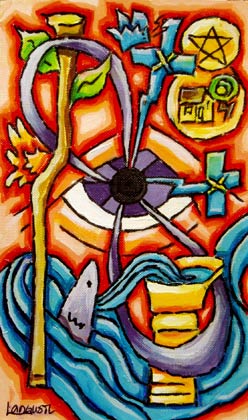 The Magician |
Suggestion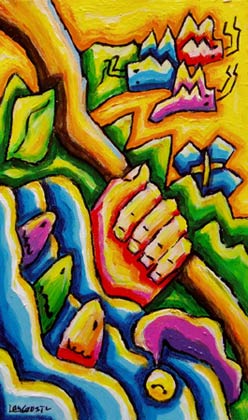 The Fool |
|
The Past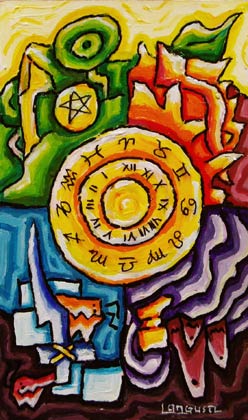 The Wheel of Fortune |
The Outcome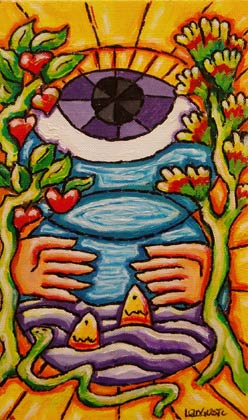 The Lovers |
The Past represents past events that are affecting the question.
The Wheel of Fortune
In the middle of the diagram three discs can be seen. I often use the number three in the descriptions as a basic universal number. The inner disc is blank. On the second disc we can make out the hourly Roman numerals. They appear anticlockwise to show that time's direction is relative.
The signs of the zodiac on the outer disc show a further meaning for the course of time. Around these discs or rings, as though one could present them how one liked, the four elements are arranged. They seem to be rotating and moving in a circle from light into dark and back again.
The Present represents the current state or immediately approaching influence.
The Magician
The symbols of all the elements are shown on the picture as possibilities. The eye, with its triangular shape, refers to the Holy Trinity. It seems as though it has just opened and one can recognise the spokes of the Wheel of Fortune in its iris.
The ribbon of eternity shows us how all possibilities can develop in waves out of the one item. The red background supports the energy of the illustration.
Hidden Influences - Things that you may not be aware of, or barely be aware of.
The High Priestess
The two eyes indicate that the High Priestess perceives the polarity in their dualism but doesn't take any valuation into account. The light and the dark side can be seen, as well as the waning and waxing moon and the full-moon, which unites and contains both sides.
The water and the two fish also symbolise the connection, the flow of energy and the dualism. The feather stands for the High Priestess' sensitiveness, the pomegranate for her fertility.
Obstacle - This is the challenge.
The Hierophant
The pentahedral star in the picture shows how the four elements, which appear in the four lower rays, come into contact with spiritualism. This is represented in the uppermost point by God's eye, in the iris of which the Wheel of Fortune is alluded to. The violet background underlines the principle of spiritualism.
The labyrinth in the middle of the star points to the search for the meaning, which by way of the heart is also a search for the centre. The two hands at the top represent the obvious (exoteric) and the concealed (esoteric). The praying hands at the bottom symbolise the pupil.
External Influences - Attitudes about this situation from people around the querent.
The Star
Nine stars are pointing towards a goal. The violet colour in the picture illustrates the spiritual atmosphere, the blue water and the fish symbolise clarity, flow of energy and liveliness, the path is well lit and seems to become easier and the sky is clearing to a light blue.
The signs of the Zodiac point towards methods, which are occupied with one's own future, and act as deputy for all oracle techniques.
Suggestion - The recommended course of action.
The Fool
The bright colours symbolise many possibilities. The Fool is holding the pilgrim's staff in his hand. Water and fish indicate openness and vivacity. The butterflies also indicate different ideas and a joy of living.
The golden yellow background gives the scene energy of life. One can see the tip of the Fool's cap. The cross, or rather the handle of the sword in the background, gives an awareness of danger, which is lurking along the path the Fool is going to take.
The Outcome - What will happen if the suggestion is followed.
The Lovers
The picture shows the connection with the opposite theme represented by two circles (blue = conscious) which combine to form an oval. The oval represents striving for unity on a higher level. The two hands stand for polarity and the confrontation with the tree of eternity and the tree of knowledge (of good and evil) with heart-shaped fruit. The serpent is coiled up at the foot of the tree of knowledge.
The yellow background emphasises the energy of the moment. Fish and water show the duality again and the produced flow of energy. The archangel Raphael watches over everyone with his blessing, indicated by God's eye.