
Relationship Spread #2
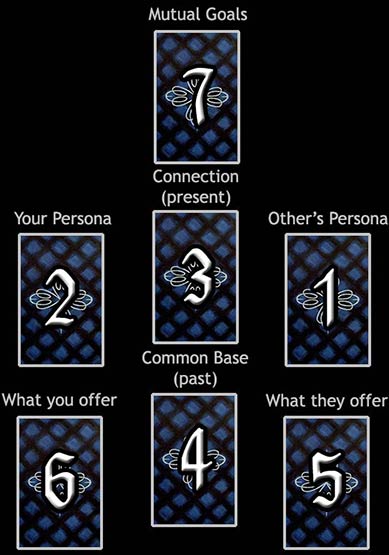
Difficulty: Easy
This relationship spread focuses more on the common ground of the relationship, with three cards in the middle column showing the common ground. The middle column essentially displays the past, present, and future of the relationship.
Card #4 stands for the common base of the relationship, which may be thought of as the past events which have shaped their characters, bringing them together. The current connection that binds them together is Card #3, indicating the values shared. Card #7 implies the common goals that would keep the pair together moving into the future.
The columns on either side show what each partner brings to the table. Remember, relationships need not be romantic, and the partners could even be groups rather than individuals. In this layout, the other person is on the left-hand side and the reader on the right.
Cards #1 & #2 indicate the separate personalities of each member of the relationship. These cards form a sort of bridge with the cards beneath them, #5 & #6, which show the qualities that each partner offers the other person, and thus to the relationship as a whole.
Your Relationship #2 Reading
Mutual Goals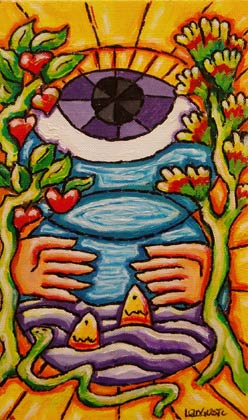 |
||
Your Qualities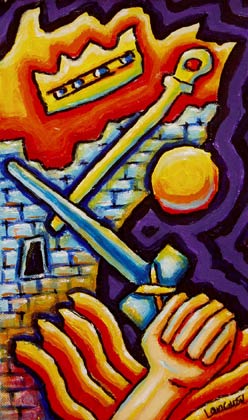 |
Connection (Present)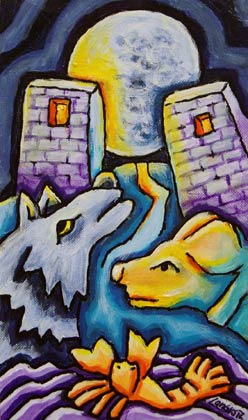 |
Others' Qualities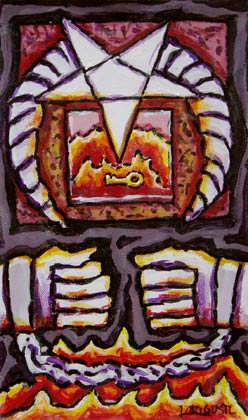 |
What You Bring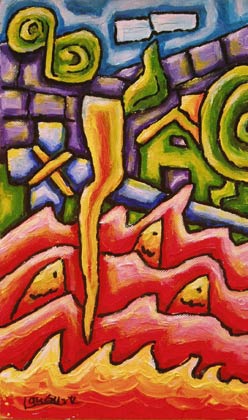 |
Common Base (Past)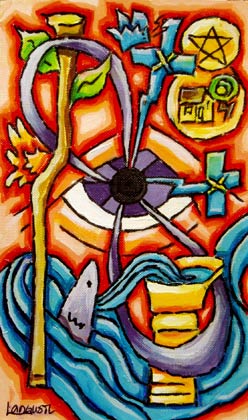 |
What They Bring 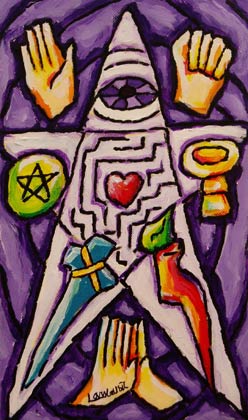 |
7: Mutual Goals
The Lovers
The picture shows the connection with the opposite theme represented by two circles (blue = conscious) which combine to form an oval. The oval represents striving for unity on a higher level. The two hands stand for polarity and the confrontation with the tree of eternity and the tree of knowledge (of good and evil) with heart-shaped fruit. The serpent is coiled up at the foot of the tree of knowledge.
The yellow background emphasises the energy of the moment. Fish and water show the duality again and the produced flow of energy. The archangel Raphael watches over everyone with his blessing, indicated by God's eye.
3: Connection
The Moon
This illustration, as with the previous ones, is based on classical examples. The moon can be seen foreshadowing its warmer and brighter side. Both towers, right and left of the path, are an indication of the Holy Jerusalem. The violet colour promises spiritual experience. To reach them the path leads past the wolf, which symbolises danger. The protecting force is portrayed by the dog, which appears lighter.
The crab, which is coming out of the water, describes the appearance out of the depths and the return to light. The crab also symbolises a character which has developed a strong contact to its emotions and intuition. Because of this it is very vulnerable and protects itself with armour and usually an extra covering.
4: Common Base
The Magician
The symbols of all the elements are shown on the picture as possibilities. The eye, with its triangular shape, refers to the Holy Trinity. It seems as though it has just opened and one can recognise the spokes of the Wheel of Fortune in its iris.
The ribbon of eternity shows us how all possibilities can develop in waves out of the one item. The red background supports the energy of the illustration.
2: Your Qualities
The Tower
A small ray of light shines through a crack in the wall and arouses our yearning for freedom and knowledge. The prison walls burst open and we can escape. We have already taken hold of the sword which stands for differentiation, consciousness and independent thought.
The monarch's insignia of the Emperor shows we are prepared to reconquer the seat on our own throne.
1: Their Qualities
The Devil
The colours black and white show the limits of a polarity, a disconnection, which cannot be outdone. The subconscious has no connection with the conscious. The burning fire points to the fact that the devil is linked with pain and torture.
The five-pointed star is upside down. The goat's horns are pointing downwards; classical symbols of the devil. The square oven symbolises the dependence on material things. Two clenched fists are chained together. Each can free the other whereby freeing itself, but only if it is brave enough to take the key from the fire. For this it has to open its hand.
6: What You Bring
Strength
5: What They Bring
The Hierophant
The pentahedral star in the picture shows how the four elements, which appear in the four lower rays, come into contact with spiritualism. This is represented in the uppermost point by God's eye, in the iris of which the Wheel of Fortune is alluded to. The violet background underlines the principle of spiritualism.
The labyrinth in the middle of the star points to the search for the meaning, which by way of the heart is also a search for the centre. The two hands at the top represent the obvious (exoteric) and the concealed (esoteric). The praying hands at the bottom symbolise the pupil.