Ankh Spread
Difficulty: Kind of tough
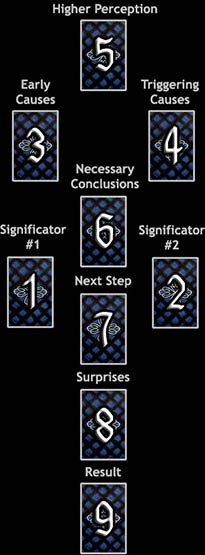
The Ankh Spread is for questions about the causes behind trends. It is similar to the Celtic Cross and Secret of the High Priestess spreads, but it covers the reasons behind the circumstances in question differently, perhaps giving a better explanation of why things are the way they are.
The loop of the upper section of the ankh reveals the spiritual background and causes of the situation, while the stem of the base focuses on prospects for the outcome.
The first two tarot cards represent the two parent causes of the situation. They will either complement each other or show two opposing sides of a conflict, depending on how they relate. These are the significator cards of the Ankh spread.
3. This tarot card shines light upon the early causes of the trend in question.
4. Pinpoints the causes that triggered the current situation.
5. Reveals the spiritual perspective of the subject at hand.
6. This card examines the reasons why this course of action had to unfold, as a means to this end.
At this point, it is good to pause to soak in the meaning of the first six cards before moving forward to the last three cards. The last three reveal prospects for the future.
7. The Next Step gives clues about the immediate future.
8. Surprising Experiences encountered en route to the result.
9. This represents the result.
Your Ankh Reading
| Early Causes | Higher Perceptions 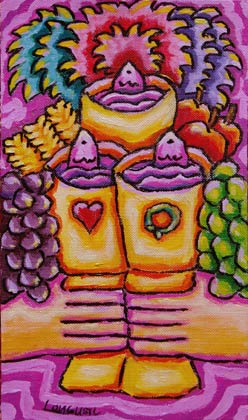 3 of Cups |
Triggering Causes |
 Temperance |
Necessary Conclusions | 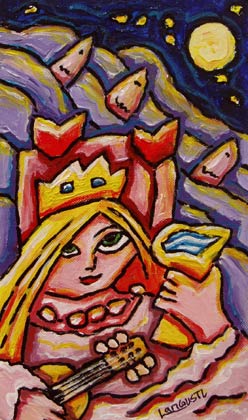 Queen of Cups |
| Significator #1 | 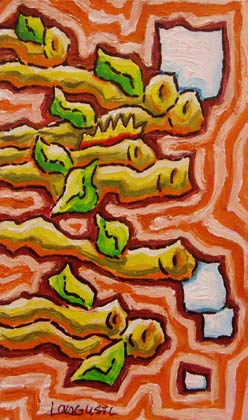 8 of Wands |
Significator #2 |
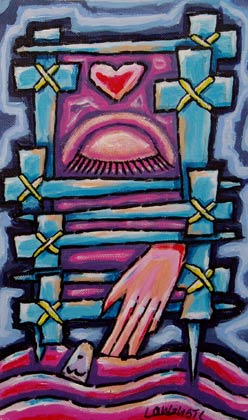 8 of Swords |
Next Step | 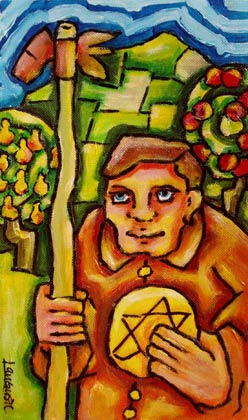 Prince of Coins |
 8 of Cups |
||
Surprising Experiences 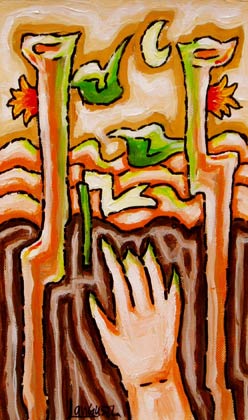 2 of Wands |
||
Outcome 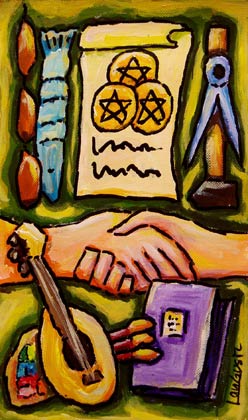 3 of Coins |
Significator #1
8 of Swords
The swords look like a cage. The eye is closed; it is looking into the inner vision; it is trying not to be aware of its own feelings. Some of the fingers are being dipped in the water; there is already contact here. The colours blue and pink show the strong contrast between understanding and emotions, which are trying clear the way for themselves.
Significator #2
Prince of Coins
The fields and fruit trees are well kept and managed. Everything seems to be in order. The harvest is certain to turn out well. Apart from a few gold buttons, the prince does without any jewellery. His facial expression mirrors his pride in his performance, but at the same time a certain submissiveness.
Early Causes
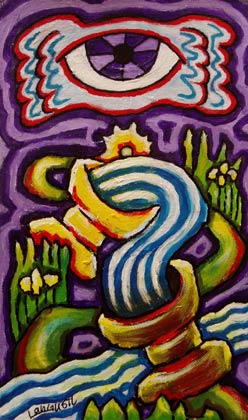
Temperance
The path through the underworld can be seen which eventually leads into light. The path is edged with lilies, the underworld flowers. The abstract archangel Michael is helping to find the right composition for the flow of energy, in other words is on the way through the subconscious (forgotten) to keep a minimal contact going with the conscious e.g., by transmission (documents...)
Triggering Causes
Queen of Cups
The world seems to be a wallowing in the emotions for the queen. The waves in the background seem to be carrying her throne, which she clearly seems to be enjoying. The moon and the stars portray the light that she intuitively or indirectly sees.
The instrument she is holding under her right arm allows her to express her inspirations and to hand them on to others. She could also be an artist.
Higher Perceptions
3 of Cups
All the equipment for a celebration is united, wine, food, fireworks, love, happiness and society. There is nothing missing. The snake, which is biting its tail, suggests that celebrations begin and end. We let them come and go, like fireworks; they do not last very long.
Necessary Conclusions
8 of Wands
The sketch quotes the picture from the Raider-Waite deck. Eight wands are flying through the air.
The Next Step
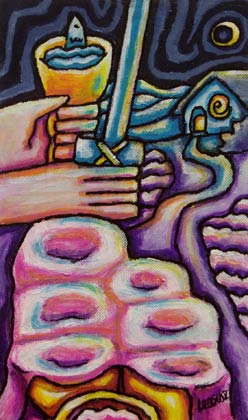
8 of Cups
Seven cups are covered with a cloth, so that they won't be damaged during absence. A cup is being held in the left hand and a sword in the right. They look like a complementary couple.
There is water to the right and left of the path and one must take care not to tread in it. In the background we can see the Hermit's hut and several hills, which could turn out to be mountains. The waxing moon shows uncertainty. The journey might not be too easy.
Surprises
2 of Wands
The picture shows coloured energy as well as a certain pallor. The brown colour suggests to us, stuck in the earth, that the right wand could help us.
The hand appears to be hesitant, the waning moon points to fear, the flag of parliament indicates false compromises. The waves in the middle show the situation's emotions.
The Outcome
3 of Coins
The picture shows an attestation as a symbol of real development and change, framed by symbols of different areas of life: a fish, sausages, a hammer and compass for handicrafts, a lute, a palette and brushes for art, a book for knowledge, appreciation and education, the two hands for social understanding.