Blind Spot Spread
Difficulty: Varies
This tarot spread is used to enhance self-awareness. Questions about learning something about oneself or things that are hidden work very well with this tarot spread, although no question is necessary.
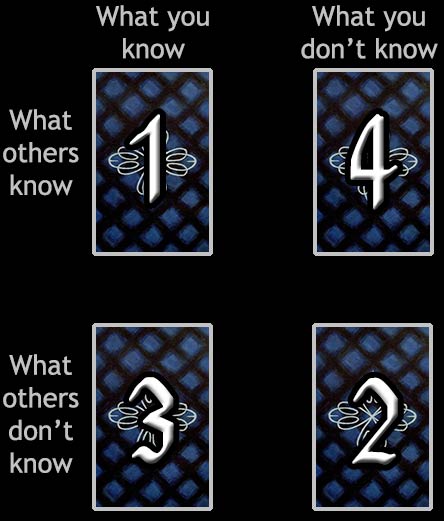
- This tarot card displays the obvious identity, the part of oneself that is consciously known and projected to others.
- This card indicates unconscious driving forces that neither the reader nor others are aware of about them, the great unknown. Nobody knows what this tarot card means, at least not yet...
- The part of oneself that is concealed, to keep others from discovering, is apparent in this card.
- This is the Blind Spot. This is what was asked about, that which this reading should bring awareness of. The reader may wish to pay close attention to these mannerisms.
Your Blind Spot Reading
| What you know | What you don't know | |
| What others know | 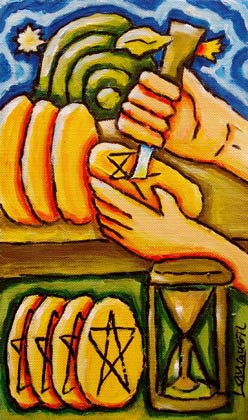 8 of Coins |
 King of Wands |
| What others don't know | 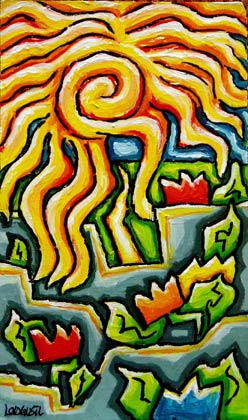 The Sun |
 2 of Swords |
This card displays your obvious identity, the part of you that everyone knows.
8 of Coins
Four pentacles are already completed and are standing under the table. They are the pentacles from the first four Pentacle cards.
The hour-glass shows that time is still needed for the work. The handle of the tool looks like a wand and indicates that, with the necessary commitment (small flame), success will slowly develop (leaf). The storm announces the future success.
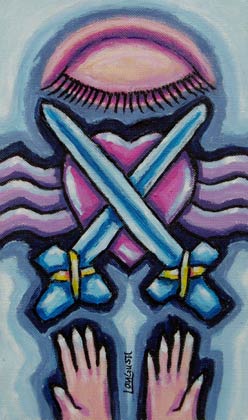
This card shows unconscious driving forces that neither you nor your company is aware of about you. This is the Great Unknown.
2 of Swords
The picture shows a closed eye. A lot is still taking place inwardly. The heart and water in a way are being crossed out. Emotions have to be left out for the moment.
The varying thoughts seem to influence one another. Both hands are open. Each thought is equally valuable at the moment.
The secrets you keep from others are shown by this card.
The Sun
The sun can be seen clearly and it dominates the picture. The last walls are being conquered and in between them flowers are already growing. This lets us suspect that the difficult path is at an end. The path, which continues, can already be seen beyond the wall.
This is your Blind Spot. This is what you asked about – what you wished to be made aware of by this reading.
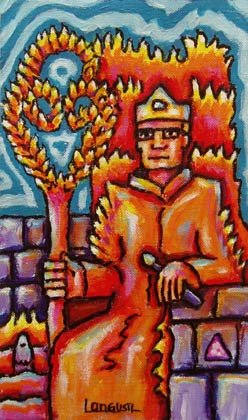
King of Wands
The wall confines the fire and bundles it up. Its violet colour shows that it has been built consciously and with spiritual energy, intent on higher ideals.
The triangle on the square shows the ideal integration of divinity and mortality. The fish in the fiery water indicates fiery emotionality as the basis for materialism. The symbol of the wand is recognised by the nine-fold loop on the back of the card.