Celtic Cross Spread
Difficulty: Average
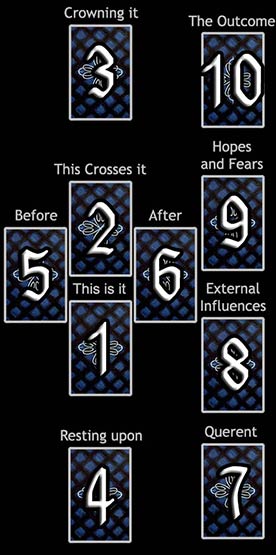
This is probably the most well-known tarot spread. A good, basic spread for beginners to practise with, the Celtic Cross is useful for questions of all types. In this spread, it can be helpful to notice the relationships between the pairings of cards #5 & #9, #1 & #2, #3 & #4, and #6 & #10.
- The significator epitomizes what the reading deals with, the initial situation.
- An added impulse that compounds the significator, which may be either complimentary or contradictory.
- This is what is consciously known (thoughts).
- Unconscious driving forces that may not be known fully (emotions).
- The immediate past regarding the current situation.
- The first future card indicates the immediate future.
- This card represents the reader and their attitude towards cards #1 and #2.
- The external influences, the places and people which influence the topic.
- This tarot card suggests expectations; what is secretly hoped for or feared.
- The second future card reveals the long-term outcome.
Your Celtic Cross Reading
The Crown |
The Outcome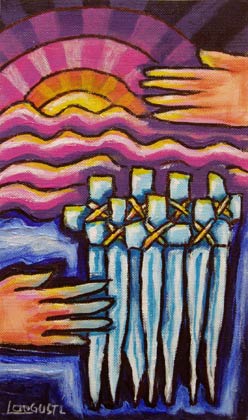 7 of Swords
External Forces 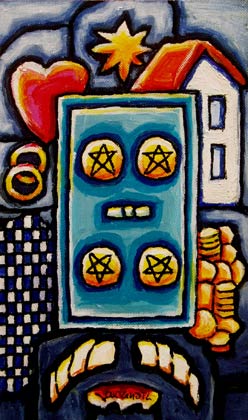 4 of Coins
|
||
The Recent Past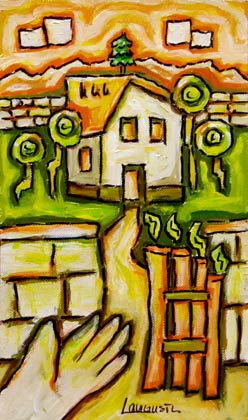 4 of Wands |
This Crosses the Significator
|
The Future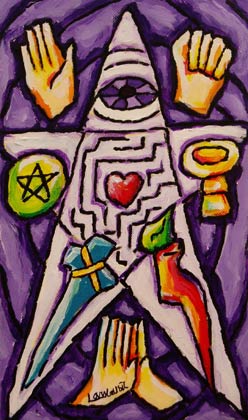 The Hierophant |
|
|
|||
The Significator represents what the main theme of the reading deals with, the initial situation.
8 of Coins
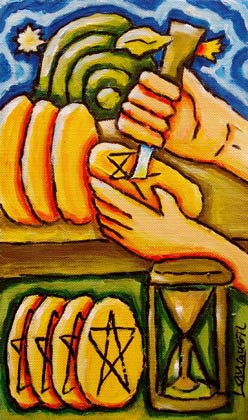
Four pentacles are already completed and are standing under the table. They are the pentacles from the first four Pentacle cards.
The hour-glass shows that time is still needed for the work. The handle of the tool looks like a wand and indicates that, with the necessary commitment (small flame), success will slowly develop (leaf). The storm announces the future success.
This Crosses the Significator denotes an added impulse that compounds the initial card, whether complimentary or contradictory.
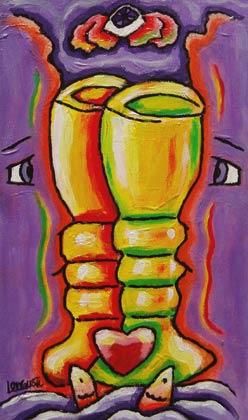
2 of Cups
The two faces and the two cups seem together to form an entirety. The difference between them is shown, among other things, through the colours, which, in each case, mirror the opposite.
Two fish in the water also suggest dualism in the unity. In the same way, the heart at the top, made of two parts, becomes one at the bottom. The suggestion of an angel above the heads supports the same theme.
The Crown stands for what the asker is aware of consciously.
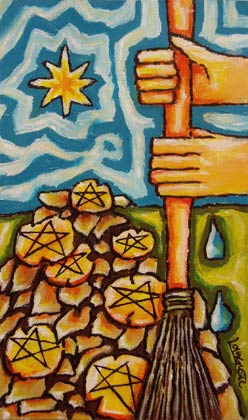
7 of Coins
Seven pentacles are lying on a heap of leaves which is being swept up. They look like unusable fruit. Two tears show that the sweeper is grieving over his lost harvest. The star in the background suggests that the loss is small in comparison with the high goal which is being aimed at.
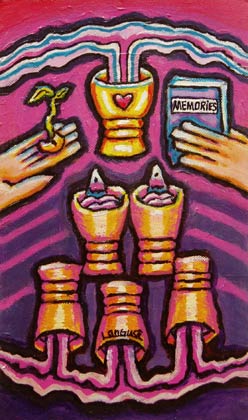
The Foundation reveals unconscious driving forces that the querent may not be aware of.
6 of Cups
The fluid in the tipped-up cups is combined with the fluid in the sixth cup to form a circle, the upper part of which seems brighter. The book with the title 'Memories' stands for achieved consciousness. The seed is germinating under the influence of other components and shows a new beginning.
The Recent Past represents past events and concerns.
4 of Wands
The colours portray richness of energy as well as naturalness and balance. The trees are young, which shows the garden has just been laid out. The small fir tree, put up for the topping-out ceremony, is still standing on the roof of the house.
The garden-gate is open and the hand is making an inviting gesture. The wall, however, gives a certain amount of protection and the door can also be closed.
The number four, noticeable in the clouds, in the number of trees and the style of the building stones, emphasise materialism. The mountains in the background indicate that this is most probably not the last project of its sort.
The Future depicts that which lies ahead.
2 of Cups
The two faces and the two cups seem together to form an entirety. The difference between them is shown, among other things, through the colours, which, in each case, mirror the opposite.
Two fish in the water also suggest dualism in the unity. In the same way, the heart at the top, made of two parts, becomes one at the bottom. The suggestion of an angel above the heads supports the same theme.
The Querent represents the asker and their attitude towards the subject of the reading.
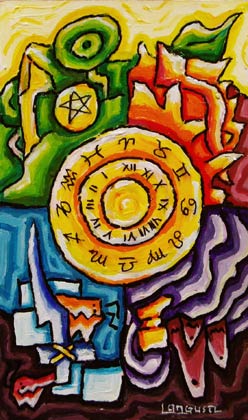
The Wheel of Fortune
In the middle of the diagram three discs can be seen. I often use the number three in the descriptions as a basic universal number. The inner disc is blank. On the second disc we can make out the hourly Roman numerals. They appear anticlockwise to show that time's direction is relative.
The signs of the zodiac on the outer disc show a further meaning for the course of time. Around these discs or rings, as though one could present them how one liked, the four elements are arranged. They seem to be rotating and moving in a circle from light into dark and back again.
External Forces represents the influence of others in your life as well as trends in your relationships with others.
4 of Coins
The safe symbolises the need for protection. Certain themes are referred to: money, possessions, love and relationships. The star stands for the vision, which is worth holding on to.
The blue-and-white checked-pattern portrays narrow-mindedness through misunderstood reliability. At the bottom of the picture the devil's horns and some hell-fire have found their place, illustrating dependence.

Hopes and Fears shows the expectations you have concerning the outcome of your question.
Prince of Swords
The strong helmet protects the prince, while, with eyes closed and head bent forward, he is demolishing the hard wall. Some bricks are falling down. A part of the wall looks like a bookcase.
This is all about ancient knowledge and opinions, the details of which are being asked about or, in the truest sense of the word, which are being blown into mid-air. However, with his eyes closed the prince cannot take into consideration what he is throwing around.
The Outcome of your question. Interpret this card in the context of the entire reading and as an indicator of the path you are currently on, but not necessarily bound to.
7 of Swords
The left hand points to the new path towards intuition and the subconscious. The colours correspond with those of the Cups. The right hand tends to turn towards the swords. This area is dominated by the colour blue. The question is how many swords should be taken on the journey.