
Relationship Spread #2
Difficulty: Easy
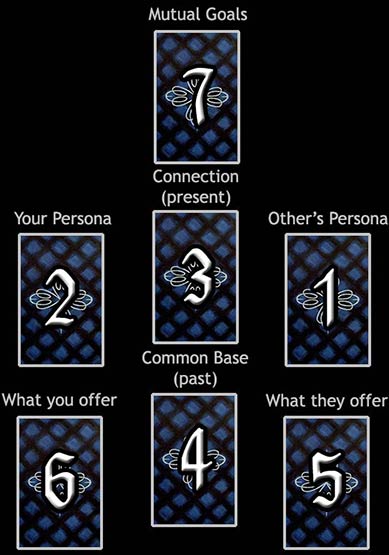
This relationship spread focuses more on the common ground of the relationship, with three cards in the middle column showing the common ground. The middle column essentially displays the past, present, and future of the relationship.
Card #4 stands for the common base of the relationship, which may be thought of as the past events which have shaped their characters, bringing them together. The current connection that binds them together is Card #3, indicating the values shared. Card #7 implies the common goals that would keep the pair together moving into the future.
The columns on either side show what each partner brings to the table. Remember, relationships need not be romantic, and the partners could even be groups rather than individuals. In this layout, the other person is on the left-hand side and the reader on the right.
Cards #1 & #2 indicate the separate personalities of each member of the relationship. These cards form a sort of bridge with the cards beneath them, #5 & #6, which show the qualities that each partner offers the other person, and thus to the relationship as a whole.
Your Relationship #2 Reading
Mutual Goals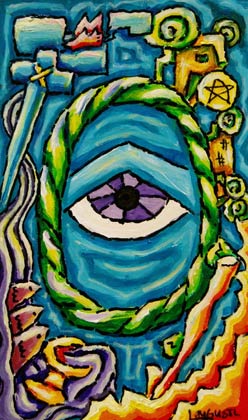 |
||
Your Qualities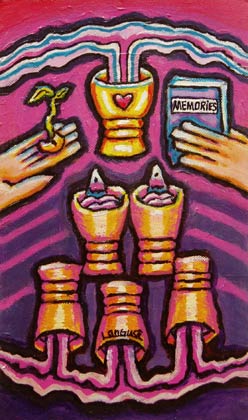 |
Connection (Present) |
Others' Qualities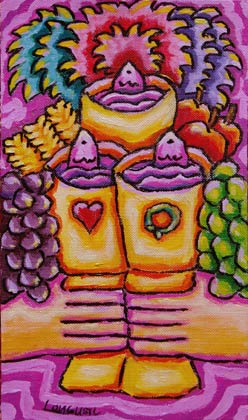 |
What You Bring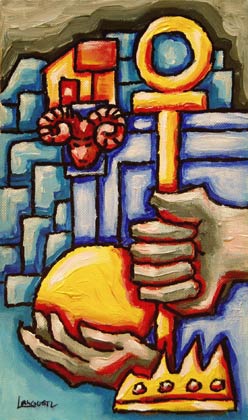 |
Common Base (Past)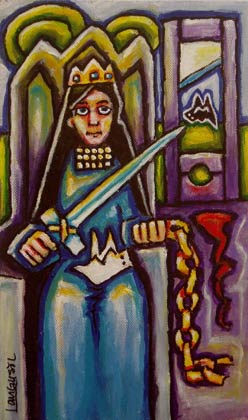 |
What They Bring 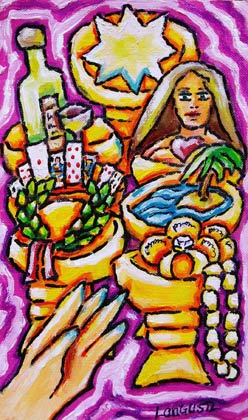 |
7: Mutual Goals
The World
The eye is the same as that on the Magician's card, but the wish to develop is not portrayed any more. The oval wreath suggests the unification of polarities, as with the Lovers, but here the unification actually takes place.
The symbols for the four elements are collected around the oval and are reconcilably united together. The blue colour of the background symbolises consciousness and clarity.
3: Connection
Prince of Coins
The fields and fruit trees are well kept and managed. Everything seems to be in order. The harvest is certain to turn out well. Apart from a few gold buttons, the prince does without any jewellery. His facial expression mirrors his pride in his performance, but at the same time a certain submissiveness.
4: Common Base
Queen of Swords
The queen is holding the butterfly carefully on her lap. At the same time, she is showing the detached chain and is banishing the black butterfly to the guillotine.
The blood on the ground shows clearly that the apparatus has already been used. She does not look callous; instead, she looks grievous and resolute. Her collar, studded with 15 precious stones, indicates she is sometimes struck dumb by little devils, the result of painful experiences.
2: Your Qualities
6 of Cups
The fluid in the tipped-up cups is combined with the fluid in the sixth cup to form a circle, the upper part of which seems brighter. The book with the title 'Memories' stands for achieved consciousness. The seed is germinating under the influence of other components and shows a new beginning.
1: Their Qualities
3 of Cups
All the equipment for a celebration is united, wine, food, fireworks, love, happiness and society. There is nothing missing. The snake, which is biting its tail, suggests that celebrations begin and end. We let them come and go, like fireworks; they do not last very long.
6: What You Bring
The Emperor
5: What They Bring
7 of Cups
Six cups contain symbols which refer to themes of illusions. The themes are intoxication (alcohol), gambling and fortune-telling (playing-cards), successful thoughts (laurel-wreath), sex and beauty (woman), wish-fulfilment (island) and wealth (money and jewels). The star in the seventh cup symbolises the vision which has to be followed.