
Three-Card Spread
Difficulty: Very easy
This simplistic chronological spread can be used to shed light on the influences that have passed, current influences, and what is approaching in the near future. Not much explanation is necessary for this simple tarot spread.
Your Three-Card Reading
The Past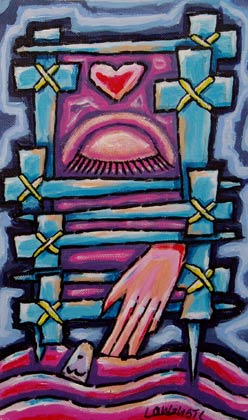 8 of Swords |
The Present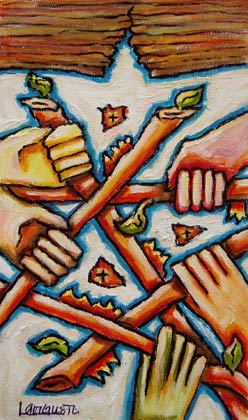 5 of Wands |
The Future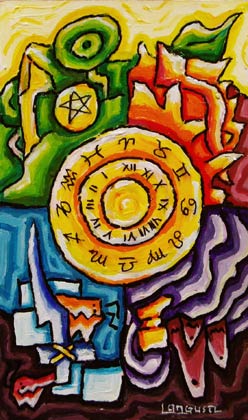 The Wheel of Fortune |
The Past
8 of Swords
The swords look like a cage. The eye is closed; it is looking into the inner vision; it is trying not to be aware of its own feelings. Some of the fingers are being dipped in the water; there is already contact here. The colours blue and pink show the strong contrast between understanding and emotions, which are trying clear the way for themselves.
The Present
5 of Wands
The beam of a building or some construction shows a definite crack and looks as if it will soon break; therefore, there is need for action. Five different coloured hands are trying to mend it by supporting the beam with stakes. But they are lacking in coordination and a united aim. One has the impression that the stakes could form an upside-down five-pointed star.
The Future
The Wheel of Fortune
In the middle of the diagram three discs can be seen. I often use the number three in the descriptions as a basic universal number. The inner disc is blank. On the second disc we can make out the hourly Roman numerals. They appear anticlockwise to show that time's direction is relative.
The signs of the zodiac on the outer disc show a further meaning for the course of time. Around these discs or rings, as though one could present them how one liked, the four elements are arranged. They seem to be rotating and moving in a circle from light into dark and back again.