
Blind Spot Spread
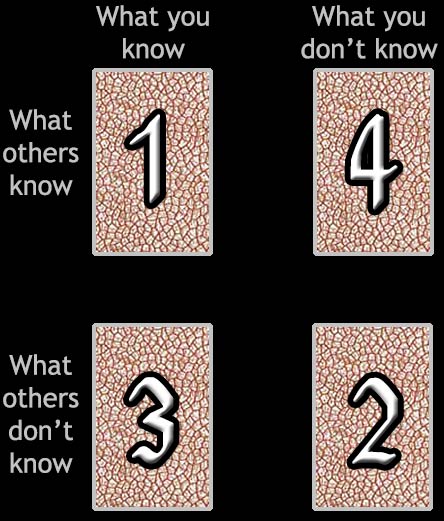
Difficulty: Varies
This tarot spread is used to enhance self-awareness. Questions about learning something about oneself or things that are hidden work very well with this tarot spread, although no question is necessary.
- This tarot card displays the obvious identity, the part of oneself that is consciously known and projected to others.
- This card indicates unconscious driving forces that neither the reader nor others are aware of about them, the great unknown. Nobody knows what this tarot card means, at least not yet...
- The part of oneself that is concealed, to keep others from discovering, is apparent in this card.
- This is the Blind Spot. This is what was asked about, that which this reading should bring awareness of. The reader may wish to pay close attention to these mannerisms.
Your Blind Spot Reading
| What you know | What you don't know | |
| What others know | 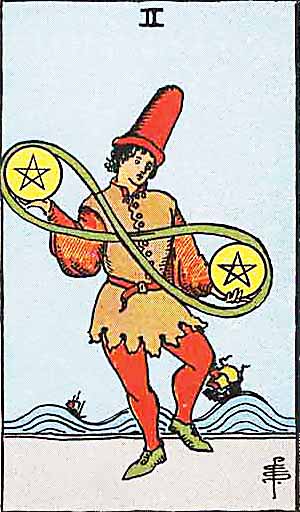 2 of Pentacles |
 5 of Pentacles |
| What others don't know | 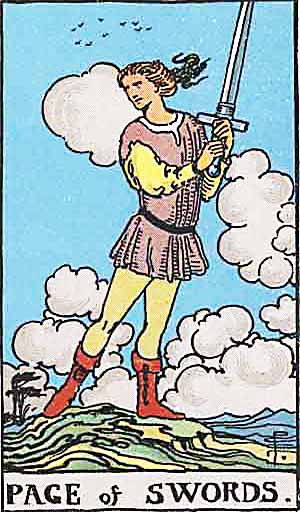 Page of Swords |
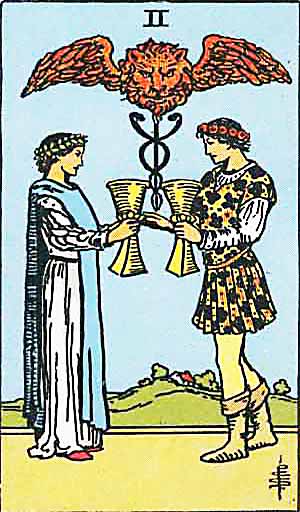 2 of Cups |
This card displays your obvious identity, the part of you that everyone knows.
2 of Pentacles
A young man, in the act of dancing, has a pentacle in either hand, and they are joined by that endless cord which is like the number eight reversed.
Divinatory Meaning:
On the one hand it is represented as a card of gaiety, recreation and its connexions, which is the subject of the design; but it is read also as news and messages in writing, as obstacles, agitation, trouble, embroilment.
This card shows unconscious driving forces that neither you nor your company is aware of about you. This is the Great Unknown.
2 of Cups
A youth and maiden are pledging one another, and above their cups rises the Caduceus of Hermes, between the great wings of which there appears a lion's head. It is a variant of a sign which is found in a few old examples of this card. Some curious emblematical meanings are attached to it, but they do not concern us in this place.
Divinatory Meaning:
Love, passion, friendship, affinity, union, concord, sympathy, the interrelation of the sexes, and – as a suggestion apart from all offices of divination – that desire which is not in Nature, but by which Nature is sanctified.
The secrets you keep from others are shown by this card.
Page of Swords
A lithe, active figure holds a sword upright in both hands, while in the act of swift walking. He is passing over rugged land, and about his way the clouds are collocated wildly. He is alert and lithe, looking this way and that, as if an expected enemy might appear at any moment.
Reversed Meaning:
What is unforeseen, unprepared state; sickness is also intimated.
This is your Blind Spot. This is what you asked about – what you wished to be made aware of by this reading.
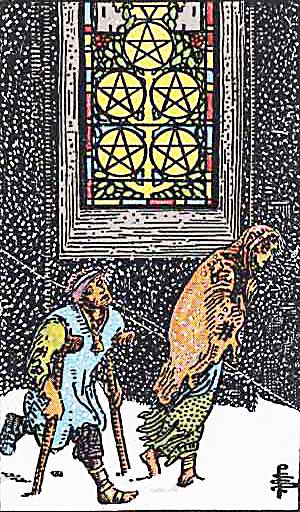
5 of Pentacles
Two mendicants in a snow-storm pass a lighted casement.
Reversed Meaning:
Disorder, chaos, ruin, discord, profligacy.