Path Spread
Difficulty: Easy
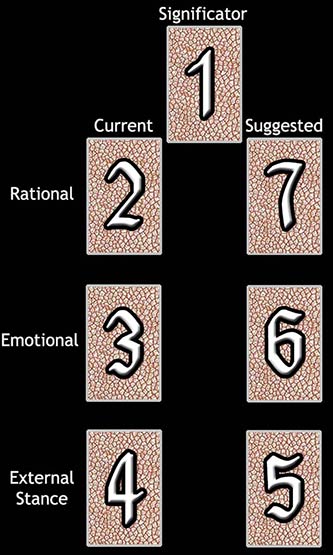
For the Path reading, one asks for suggestions how to behave properly to achieve a desired result. The Current column represents how the reader has been acting, and the Suggestedcolumn suggests how they should act to achieve a certain goal. The chart-like spread uses the standard three levels: Rational, Emotional, and External Stance (how one projects oneself outwardly). When comparing the Current and Suggested cards, the most important thing is to notice the differences between the two cards. It is these differences which hint at the behaviours that should be altered.
Card #1 is the significator, the card which should reflect the nature of the query and/or the desired outcome.
Card #2 shows the way the reader is and has been thinking. Card #7 suggests how to change the way one thinks to serve themselves better.
Card #3 suggests the reader's emotional attitude. Though it may seem difficult to manipulate one's own emotions, it can be done if one puts their mind to it. For example, acting a certain way such as smiling intently for a few minutes will lead the emotions to follow. When a person tries this, as silly as the exercise seems, they find this to evoke the emotion of happiness. For this reading, one should try to make themselves feel the way that Card #6 suggests.
External Stance means how one acts outwardly, how they hope others see them. Card #4 is about how the reader has been acting, while #5 indicates how they should act outwardly, for other people's sake. It is the differences between these cards that hint at what behaviour patterns should be altered.
Your Path Reading
| Current | The Significator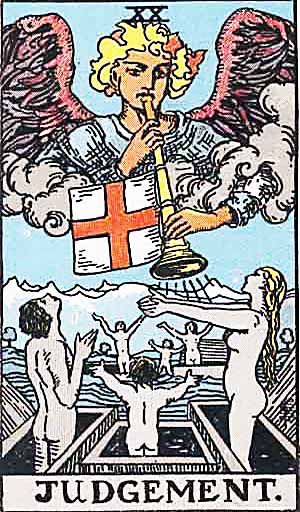 Judgement |
Suggested | |
| Thought | 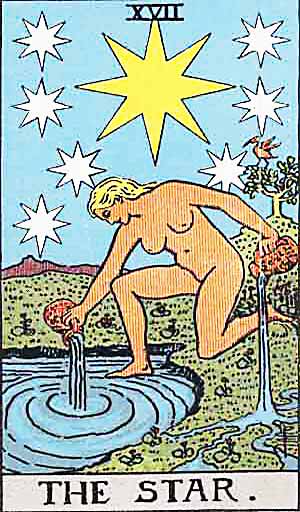 The Star |
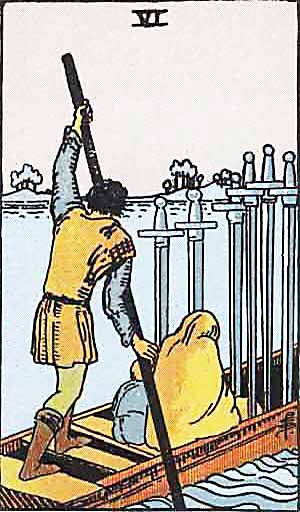 6 of Swords |
|
| Emotion | 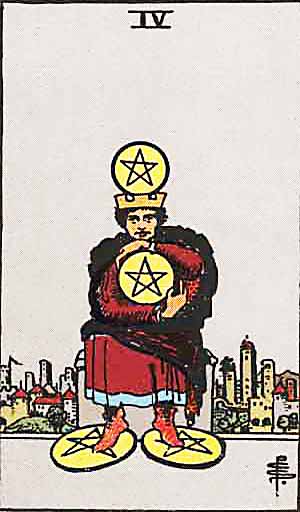 4 of Pentacles |
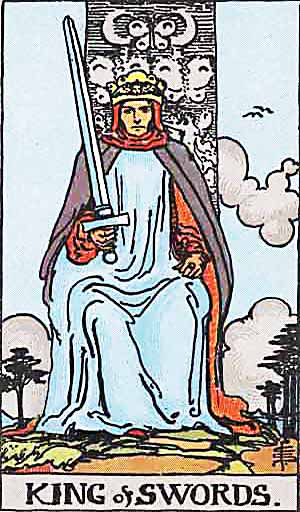 King of Swords |
|
| External Stance | 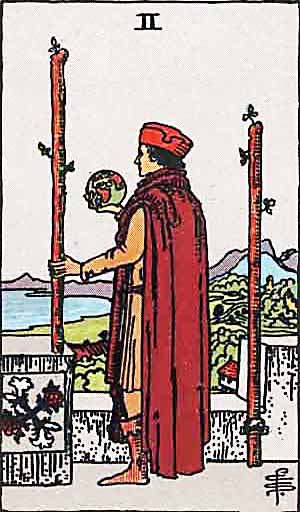 2 of Wands |
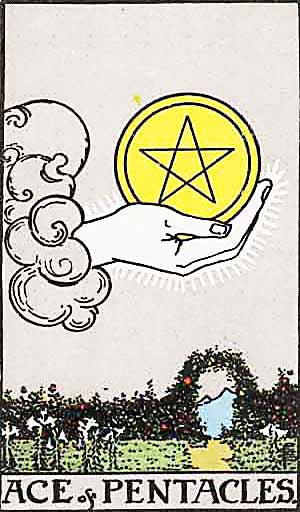 Ace of Pentacles |
The Significator
Judgement
The great angel is here encompassed by clouds, but he blows his bannered trumpet, and the cross as usual is displayed on the banner. The dead are rising from their tombs – a woman on the right, a man on the left hand, and between them their child, whose back is turned. But in this card there are more than three who are restored, and it has been thought worthwhile to make this variation as illustrating the insufficiency of current explanations. It should be noted that all the figures are as one in the wonder, adoration and ecstasy expressed by their attitudes. It is the card which registers the accomplishment of the great work of transformation in answer to the summons of the Supernal – which summons is heard and answered from within.
Herein is the intimation of a significance which cannot well be carried further in the present place. What is that within us which does sound a trumpet and all that is lower in our nature rises in response – almost in a moment, almost in the twinkling of an eye? Let the card continue to depict, for those who can see no further, the Last judgment and the resurrection in the natural body; but let those who have inward eyes look and discover therewith. They will understand that it has been called truly in the past a card of eternal life, and for this reason it may be compared with that which passes under the name of Temperance.
Divinatory Meaning:
Change of position, renewal, outcome. Another account specifies total loss though lawsuit.
Current Thoughts
The Star
A great, radiant star of eight rays, surrounded by seven lesser stars – also, of eight rays. The female figure in the foreground is entirely naked. Her left knee is on the land and her right foot upon the water. She pours Water of Life from two great ewers, irrigating sea and land. Behind her is rising ground and on the right a shrub or tree, whereon a bird alights. The figure expresses eternal youth and beauty. The star is l'etoile flamboyante, which appears in Masonic symbolism, but has been confused therein. That which the figure communicates to the living scene is the substance of the heavens and the elements. It has been said truly that the mottoes of this card are Waters of Life freely and Gifts of the Spirit.
The summary of several tawdry explanations says that it is a card of hope. On other planes it has been certified as immortality and interior light. For the majority of prepared minds, the figure will appear as the type of Truth unveiled, glorious in undying beauty, pouring on the waters of the soul some part and measure of her priceless possession. But she is in reality the Great Mother in the Kabalistic Sephira Binah, which is supernal Understanding, who communicates to the Sephiroth that are below in the measure that they can receive her influx.
Divinatory Meaning:
Eternal youth and beauty, gifts of the spirit, hope and bright prospects.
Suggested Thoughts
6 of Swords
A ferryman carrying passengers in his punt to the further shore. The course is smooth, and seeing that the freight is light, it may be noted that the work is not beyond his strength.
Divinatory Meaning:
Journey by water, route, way, envoy, commissionary, expedient.
Current Emotions
4 of Pentacles
A crowned figure, having a pentacle over his crown, clasps another with hands and arms; two pentacles are under his feet. He holds to that which he has.
Reversed Meaning:
Suspense, delay, opposition.
Suggested Emotions
King of Swords
He sits in judgment, holding the unsheathed sign of his suit. He recalls, of course, the conventional Symbol of justice in the Trumps Major, and he may represent this virtue, but he is rather the power of life and death, in virtue of his office.
Divinatory Meaning:
Whatsoever arises out of the idea of judgment and all its connexions – power, command, authority, militant intelligence, law, offices of the crown, and so forth.
Current External Stance
2 of Wands
A tall man looks from a battlemented roof over sea and shore; he holds a globe in his right hand, while a staff in his left rests on the battlement; another is fixed in a ring. The Rose and Cross and Lily should be noticed on the left side.
Divinatory Meaning:
Between the alternative readings there is no marriage possible; on the one hand, riches, fortune, magnificence; on the other, physical suffering, disease, chagrin, sadness, mortification. The design gives one suggestion; here is a lord overlooking his dominion and alternately contemplating a globe; it looks like the malady, the mortification, the sadness of Alexander amidst the grandeur of this world's wealth.
A young lady may expect trivial disappointments.
Suggested External Stance
Ace of Pentacles
A hand – issuing, as usual, from a cloud – holds up a pentacle.
Reversed Meaning:
The evil side of wealth, bad intelligence; also, great riches. In any case it shews prosperity, comfortable material conditions, but whether these are of advantage to the possessor will depend on whether the card is reversed or not.