
Relationship Spread #2
Difficulty: Easy
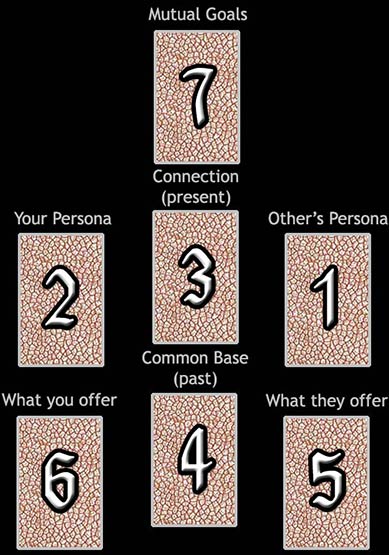
This relationship spread focuses more on the common ground of the relationship, with three cards in the middle column showing the common ground. The middle column essentially displays the past, present, and future of the relationship.
Card #4 stands for the common base of the relationship, which may be thought of as the past events which have shaped their characters, bringing them together. The current connection that binds them together is Card #3, indicating the values shared. Card #7 implies the common goals that would keep the pair together moving into the future.
The columns on either side show what each partner brings to the table. Remember, relationships need not be romantic, and the partners could even be groups rather than individuals. In this layout, the other person is on the left-hand side and the reader on the right.
Cards #1 & #2 indicate the separate personalities of each member of the relationship. These cards form a sort of bridge with the cards beneath them, #5 & #6, which show the qualities that each partner offers the other person, and thus to the relationship as a whole.
Your Relationship #2 Reading
Mutual Goals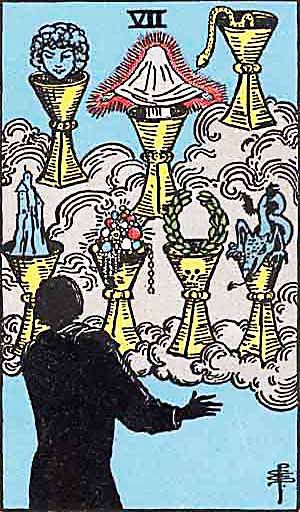 |
||
Your Qualities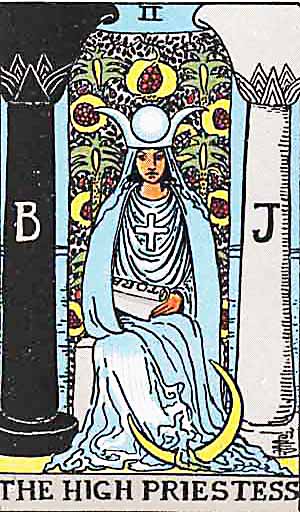 |
Connection (Present)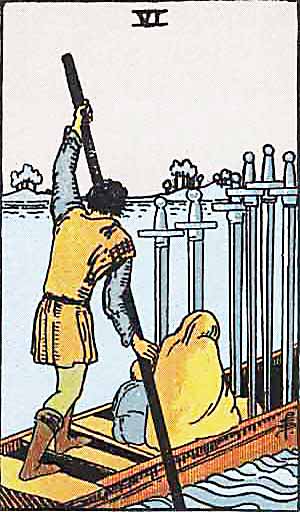 |
Others' Qualities |
What You Bring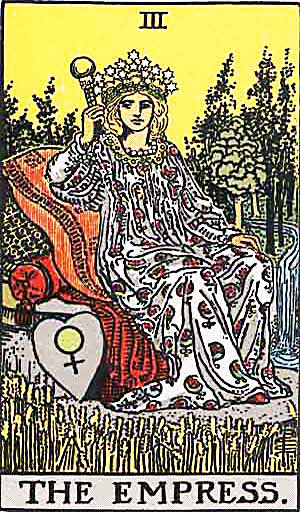 |
Common Base (Past)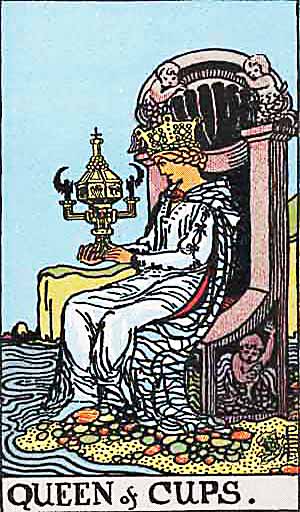 |
What They Bring 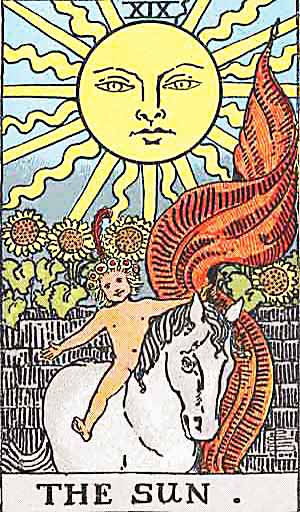 |
7: Mutual Goals
7 of Cups
Strange chalices of vision, but the images are more especially those of the fantastic spirit.
Reversed Meaning:
Desire, will, determination, project.
3: Connection
6 of Swords
A ferryman carrying passengers in his punt to the further shore. The course is smooth, and seeing that the freight is light, it may be noted that the work is not beyond his strength.
Reversed Meaning:
Declaration, confession, publicity; one account says that it is a proposal of love.
4: Common Base
Queen of Cups
Beautiful, fair, dreamy – as one who sees visions in a cup. This is, however, only one of her aspects; she sees, but she also acts, and her activity feeds her dream.
Divinatory Meaning:
Good, fair woman; honest, devoted woman, who will do service to the Querent; loving intelligence, and hence the gift of vision; success, happiness, pleasure; also, wisdom, virtue; a perfect spouse and a good mother.
2: Your Qualities
The High Priestess
She has the lunar crescent at her feet, a horned diadem on her head, with a globe in the middle place, and a large solar cross on her breast. The scroll in her hands is inscribed with the word Tora, signifying the Greater Law, the Secret Law and the second sense of the Word. It is partly covered by her mantle, to shew that some things are implied and some spoken. She is seated between the white and black pillars – J. and B. – of the mystic Temple, and the veil of the Temple is behind her: it is embroidered with palms and pomegranates. The vestments are flowing and gauzy, and the mantle suggests light – a shimmering radiance. She has been called occult Science on the threshold of the Sanctuary of Isis, but she is really the Secret Church, the House which is of God and man. She represents also the Second Marriage of the Prince who is no longer of this world; she is the spiritual Bride and Mother, the daughter of the stars and the Higher Garden of Eden. She is, in fine, the Queen of the borrowed light, but this is the light of all. She is the Moon nourished by the milk of the Supernal Mother.
In a manner, she is also the Supernal Mother herself – that is to say, she is the bright reflection. It is in this sense of reflection that her truest and highest name in bolism is Shekinah – the co-habiting glory. According to Kabalism, there is a Shekinah both above and below. In the superior world it is called Binah, the Supernal Understanding which reflects to the emanations that are beneath. In the lower world it is MaIkuth – that world being, for this purpose, understood as a blessed Kingdom that with which it is made blessed being the Indwelling Glory. Mystically speaking, the Shekinah is the Spiritual Bride of the just man, and when he reads the Law she gives the Divine meaning. There are some respects in which this card is the highest and holiest of the Greater Arcana.
Reversed Meaning:
Passion, moral or physical ardour, conceit, surface knowledge.
1: Their Qualities
7 of Swords
A man in the act of carrying away five swords rapidly; the two others of the card remain stuck in the ground. A camp is close at hand.
Divinatory Meaning:
Design, attempt, wish, hope, confidence; also quarrelling, a plan that may fail, annoyance. The design is uncertain in its import, because the significations are widely at variance with each other.
6: What You Bring
The Empress
5: What They Bring
The Sun
The naked child mounted on a white horse and displaying a red standard has been mentioned already as the better symbolism connected with this card. It is the destiny of the Supernatural East and the great and holy light which goes before the endless procession of humanity, coming out from the walled garden of the sensitive life and passing on the journey home. The card signifies, therefore, the transit from the manifest light of this world, represented by the glorious sun of earth, to the light of the world to come, which goes before aspiration and is typified by the heart of a child.
But the last allusion is again the key to a different form or aspect of the symbolism. The sun is that of consciousness in the spirit – the direct as the antithesis of the reflected light. The characteristic type of humanity has become a little child therein – a child in the sense of simplicity and innocence in the sense of wisdom. In that simplicity, he bears the seal of Nature and of Art; in that innocence, he signifies the restored world. When the self-knowing spirit has dawned in the consciousness above the natural mind, that mind in its renewal leads forth the animal nature in a state of perfect conformity.
Reversed Meaning:
Material happiness, fortunate marriage, contentment – but in a lesser sense than if upright.