
Three-Card Spread
Difficulty: Very easy
This simplistic chronological spread can be used to shed light on the influences that have passed, current influences, and what is approaching in the near future. Not much explanation is necessary for this simple tarot spread.
Your Three-Card Tarot Reading with the Rider Waite
The Past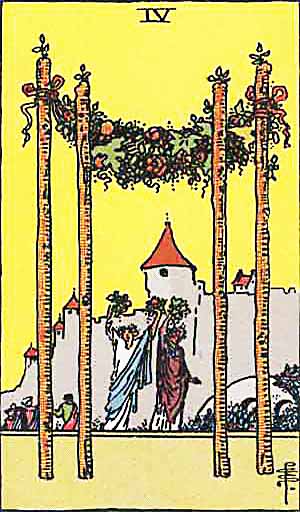 4 of Wands |
The Present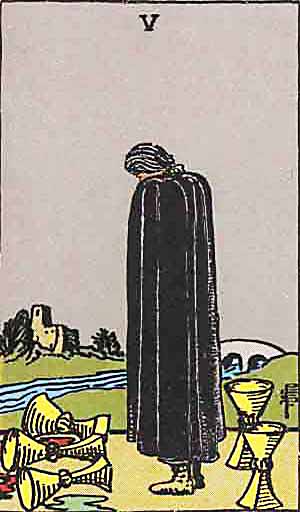 5 of Cups |
The Future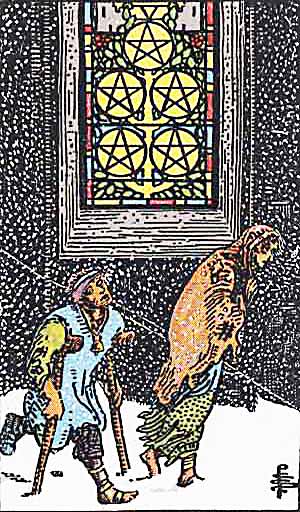 5 of Pentacles |
The Past
4 of Wands
From the four great staves planted in the foreground there is a great garland suspended; two female figures uplift nosegays; at their side is a bridge over a moat, leading to an old manorial house.
Divinatory Meaning:
They are for once almost on the surface – country life, haven of refuge, a species of domestic harvest-home, repose, concord, harmony, prosperity, peace, and the perfected work of these.
The Present
5 of Cups
A dark, cloaked figure, looking sideways at three prone cups two others stand upright behind him; a bridge is in the background, leading to a small keep or holding.
Divinatory Meaning:
It is a card of loss, but something remains over; three have been taken, but two are left; it is a card of inheritance, patrimony, transmission, but not corresponding to expectations; with some interpreters it is a card of marriage, but not without bitterness or frustration.
The Future
5 of Pentacles
Two mendicants in a snow-storm pass a lighted casement.
Divinatory Meaning:
The card foretells material trouble above all, whether in the form illustrated – that is, destitution – or otherwise. For some cartomancers, it is a card of love and lovers – wife, husband, friend, mistress; also, concordance, affinities. These alternatives cannot be harmonised.