
Ankh Spread
Difficulty: Kind of tough
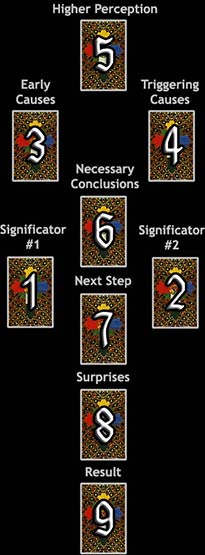
The Ankh Spread is for questions about the causes behind trends. It is similar to the Celtic Cross and Secret of the High Priestess spreads, but it covers the reasons behind the circumstances in question differently, perhaps giving a better explanation of why things are the way they are.
The loop of the upper section of the ankh reveals the spiritual background and causes of the situation, while the stem of the base focuses on prospects for the outcome.
The first two tarot cards represent the two parent causes of the situation. They will either complement each other or show two opposing sides of a conflict, depending on how they relate. These are the significator cards of the Ankh spread.
3. This tarot card shines light upon the early causes of the trend in question.
4. Pinpoints the causes that triggered the current situation.
5. Reveals the spiritual perspective of the subject at hand.
6. This card examines the reasons why this course of action had to unfold, as a means to this end.
At this point, it is good to pause to soak in the meaning of the first six cards before moving forward to the last three cards. The last three reveal prospects for the future.
7. The Next Step gives clues about the immediate future.
8. Surprising Experiences encountered en route to the result.
9. This represents the result.
Your Ankh Tarot Reading with the Book of Thoth
Higher Perceptions 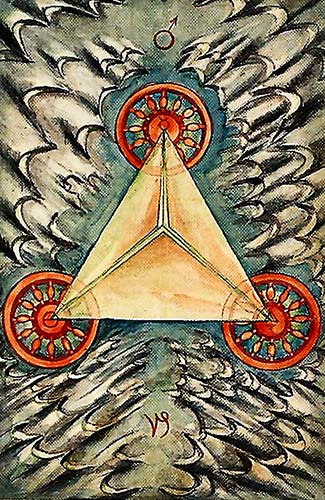 3 of Disks |
||
Early Causes
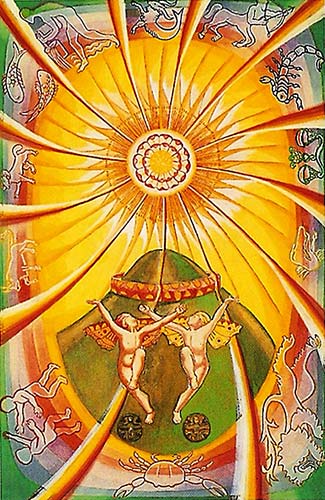 The Sun |
Triggering Causes
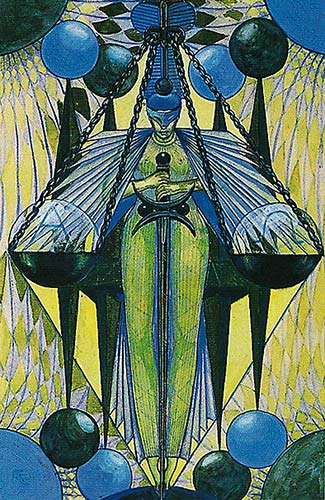 Adjustment |
|
Necessary Conclusions
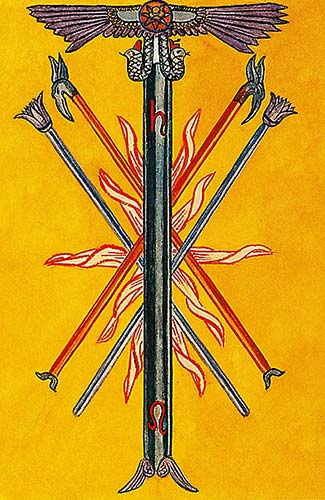 5 of Wands |
||
Significator #1
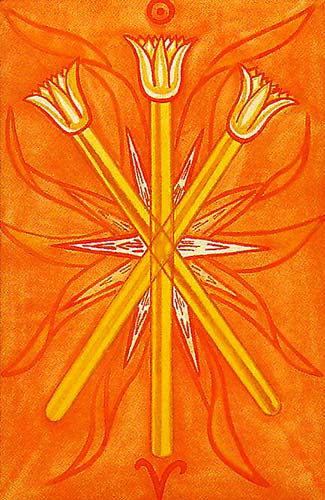 3 of Wands |
Significator #2
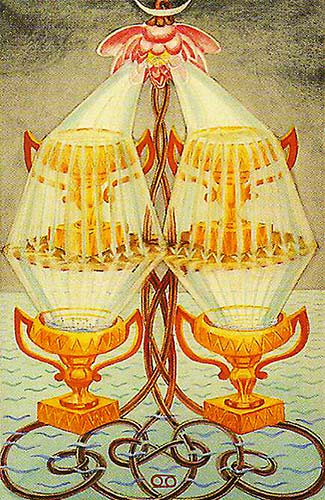 4 of Cups |
|
Next Step
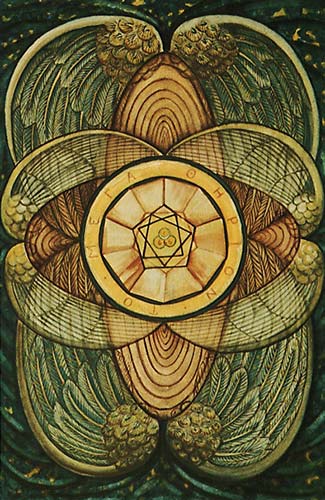 Ace of Disks |
||
Surprising Experiences 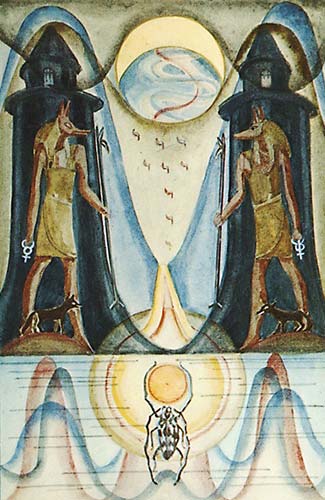 The Moon |
||
Outcome 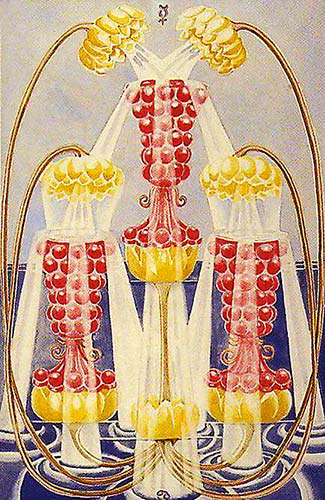 3 of Cups |
Significator #1
3 of Wands
Sun in Aries – Virtue
This card refers to Binah in the suit of Fire, and so represents the establishment of primeval Energy. The Will has been trans mitted to the Mother, who conceives, prepares, and gives birth to, its manifestation. It refers to the Sun in Aries, the Sign in which he is exalted.
The meaning is harmonious, for this is the beginning of Spring. For this reason, one sees the wand taking the form of the Lotus in blossom. The Sun has enkindled the Great Mother.
Significator #2
4 of Cups
Moon in Cancer – Luxury
This card refers to Chesed in the sphere of Water. Here, below the Abyss, the energy of this element, although ordered, balanced and (for the moment) stabilised, has lost the original purity of the conception. The card refers to the Moon in Cancer, which is her own house; but Cancer itself is so placed that this implies a certain weakness, an abandonment to desire. This tends to introduce the seeds of decay into the fruit of pleasure.
The sea is still shown, but its surface is ruffled, and the four Cups which stand upon it are no longer so stable. The Lotus from which the water Springs has a multiple stem, as if to show that the influence of the Dyad has gathered strength.
Early Causes
The Sun
The Sun
Glory, gain, riches, triumph, pleasure, frankness, truth, shame-lessness, arrogance, vanity, manifestation, recovery from sickness, but sometimes sudden death.
Triggering Causes
Adjustment
Libra
Justice, or rather justesse, the act of adjustment, suspension of all action pending decision; in material matters, may refer to law suits or prosecutions. Socially, marriage or marriage agreements; politically, treaties.
Higher Perceptions
3 of Disks
Mars in Capricorn – Works
The influence of Binah in the sphere of Earth shows the material establishment of the idea of the Universe, the determination of its basic form. It is ruled by Mars in Capricornus; he is exalted in that Sign, and therefore at his best. His energy is constructive, like that of the builder or engineer. The card represents a pyramid viewed from above the apex.
This pyramid is situated in the great Sea of Binah in the Night of Time, but the sea is solidified; hence the colours of the background are mottled, a cold thin dark grey with a pattern of indigo and green. The sides of the pyramid have a strong reddish tint, showing the influence of Mars.
Necessary Conclusions
5 of Wands
Saturn in Leo – Strife
This card is referred to Geburah of the suit of Fire. Geburah itself being fiery, it is a purely active force. It is ruled also by Saturn and Leo. Leo shows the element of Fire at its strongest and most balanced. Saturn tends to weigh it down and to embitter it. There is no limit to the scope of this volcanic energy.
The symbol represents the wand of the Chief Adept, showing that the authority is derived from the superiors; were it not so, this card would be thoroughly disastrous. Moreover, there are also two wands of the Second, or Major Adept. They have the head of the Phoenix, which gives the idea of destruction (or rather purgation) through fire, and the resurrection of the energy from its ashes.
The Next Step
Ace of Disks
The Root of Earth
The Ace of Disks pictures the entry of that type of Energy which is called Earth. About this whirling Disk are its six Wings; the entire symbol is not only a glyph of Earth as understood in this New Aeon of Horus, but of the number 6, the number of the Sun. This card is thus an affirmation of the identity of Sol and Terra.
Surprises
The Moon
Pisces
Illusion, deception, bewilderment, hysteria, even madness, dreaminess, falsehood, error, crisis, 'the darkest hour before the dawn', the brink of important change.
The Outcome
3 of Cups
Mercury in Cancer – Abundance
This card refers to Binah in the suit of Water. This is the card of Demeter or Persephone. The Cups are pomegranates: they are filled bountifully to overflowing a single lotus, arising from the dark calm sea characteristic of Binah. There is here the fulfilment of the Will of Love in abounding joy. It is the spiritual basis of fertility.
The card is referred to the influence of Mercury in Cancer; this carries further the above thesis. Mercury is the Will or Word of the All-Father; here its influence descends upon the most receptive of the Signs. At the same time, the combination of these forms of energy brings in the possibility of somewhat mysterious ideas. Binah, the Great Sea, is the Moon in one aspect, but Saturn in another; and Mercury, besides being the Word or Will of the All-One, is the guide of the souls of the Dead. The pomegranate was the fruit which Persephone ate in the realms of Pluto, thereby enabling him to hold her in the lower world, even after the most powerful influence had been brought to bear. The lesson seems to be that the good things of life, although enjoyed, should be distrusted.