Celtic Cross Spread
Difficulty: Average
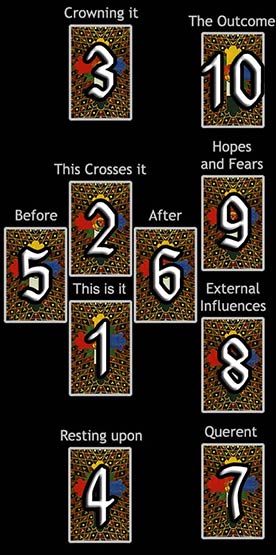
This is probably the most well-known tarot spread. A good, basic spread for beginners to practise with, the Celtic Cross is useful for questions of all types. In this spread, it can be helpful to notice the relationships between the pairings of cards #5 & #9, #1 & #2, #3 & #4, and #6 & #10.
- The significator epitomizes what the reading deals with, the initial situation.
- An added impulse that compounds the significator, which may be either complimentary or contradictory.
- This is what is consciously known (thoughts).
- Unconscious driving forces that may not be known fully (emotions).
- The immediate past regarding the current situation.
- The first future card indicates the immediate future.
- This card represents the reader and their attitude towards cards #1 and #2.
- The external influences, the places and people which influence the topic.
- This tarot card suggests expectations; what is secretly hoped for or feared.
- The second future card reveals the long-term outcome.
Your Celtic Cross Tarot Reading with the Book of Thoth
The Crown |
The Outcome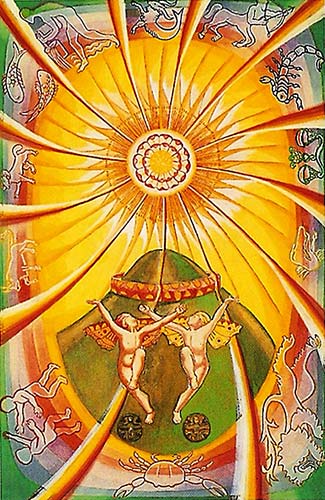 The Sun
External Forces 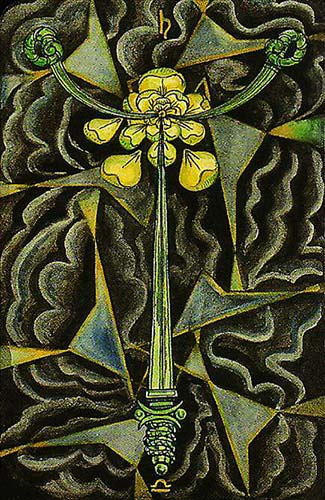 3 of Swords
|
||
The Recent Past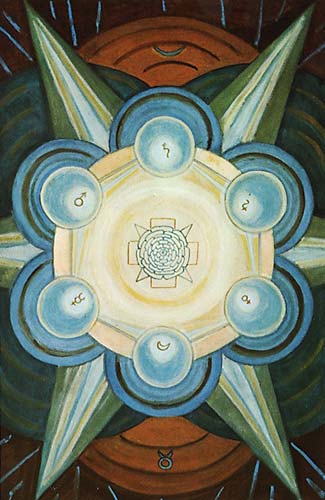 6 of Disks |
This Crosses the Significator
|
The Future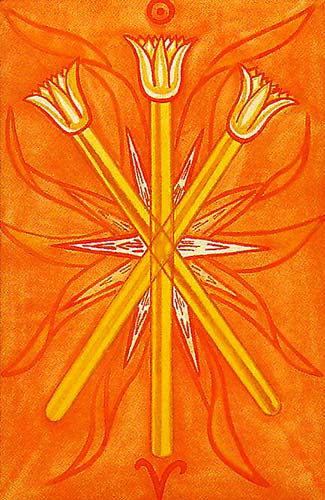 3 of Wands |
|
|
|||
The Significator represents what the main theme of the reading deals with, the initial situation.
4 of Wands
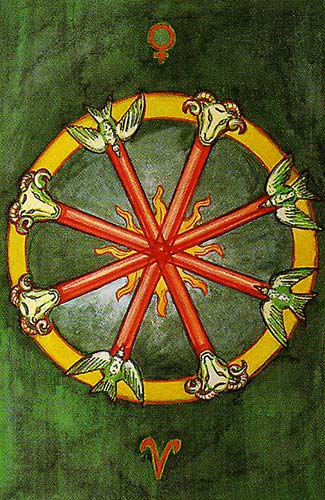
Venus in Aries – Completion
This card refers to Chesed in the suit of Fire. Being below the Abyss, it is the Lord of all manifested active Power. The original Will of the Two has been transmitted through the Three, and is now built up into a solid system: Order, Law, Government. It is also referred to Venus in Aries, which indicates that one cannot establish one's work without tact and gentleness. The wands are headed by the Ram, sacred to Chesed, the Father-god Amoun-Ra, as also to Aries; but at the other end of the wands are the Doves of Venus.
In the symbol, the ends of the wands touch a circle, showing the completion and limitation of the original work. It is within this circle that the flames (four double, as if to assert the balance) of the Energy are seen to play, and there is no intention to increase the scope of the original Will.

This Crosses the Significator denotes an added impulse that compounds the initial card, whether complimentary or contradictory.
The Magus
Mercury
Skill, wisdom, adroitness, elasticity, craft, cunning, deceit, theft. Sometimes occult wisdom or power, sometimes a quick impulse, a brain-wave. It may imply messages, business transactions, the interference of learning or intelligence with the matter in hand.
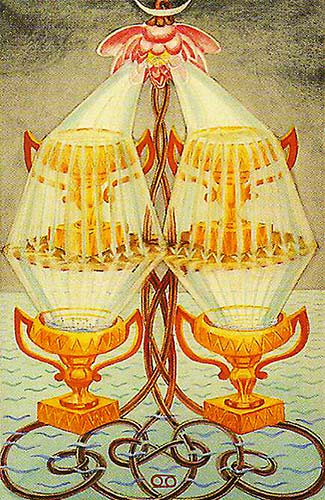
The Crown stands for what the asker is aware of consciously.
4 of Cups
Moon in Cancer – Luxury
This card refers to Chesed in the sphere of Water. Here, below the Abyss, the energy of this element, although ordered, balanced and (for the moment) stabilised, has lost the original purity of the conception. The card refers to the Moon in Cancer, which is her own house; but Cancer itself is so placed that this implies a certain weakness, an abandonment to desire. This tends to introduce the seeds of decay into the fruit of pleasure.
The sea is still shown, but its surface is ruffled, and the four Cups which stand upon it are no longer so stable. The Lotus from which the water Springs has a multiple stem, as if to show that the influence of the Dyad has gathered strength.
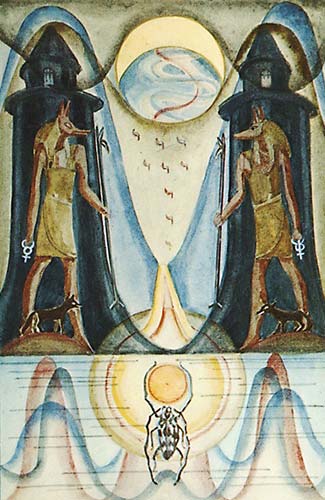
The Foundation reveals unconscious driving forces that the querent may not be aware of.
The Moon
Pisces
Illusion, deception, bewilderment, hysteria, even madness, dreaminess, falsehood, error, crisis, 'the darkest hour before the dawn', the brink of important change.
The Recent Past represents past events and concerns.
6 of Disks
Moon in Taurus – Success
The Number Six, Tiphareth, as before, represents the full harmonious establishment of the Energy of the Element. The Moon in Taurus rules the card; and this, while increasing the approach to perfection (for the Moon is exalted in Taurus and therefore in her highest form) marks that the condition is transient.
The disks are arranged in the form of the Hexagram, which is shown in skeleton. In the centre blushes and glows the light rose- madder of dawn, and without are three concentric circles, golden yellow, salmon-pink, and amber. These colours show Tiphareth fully realised on Earth; it reaffirms in form what was mathematically set forth in describing the Ace. The planets are arranged in accordance with their usual attribution; but they are only shown as disks irradiated by the Sun in their centre. This Sun is idolised as the Rose and Cross; the Rose has forty-nine petals, the interplay of the Seven with the Seven.
The Future depicts that which lies ahead.
The Magus
Mercury
Skill, wisdom, adroitness, elasticity, craft, cunning, deceit, theft. Sometimes occult wisdom or power, sometimes a quick impulse, a brain-wave. It may imply messages, business transactions, the interference of learning or intelligence with the matter in hand.
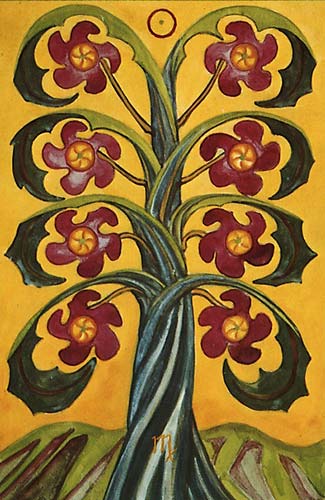
The Querent represents the asker and their attitude towards the subject of the reading.
8 of Disks
Sun in Virgo – Prudence
The number Eight, Hod, is very helpful in this card, because it represents Mercury in his most spiritual aspect, and he both rules and is exalted in the sign of Virgo, which belongs to the Decan, and is governed by the Sun. It signifies intelligence lovingly applied to material matters, especially those of the agriculturalist, the artificer and the engineer.
One might suggest that this card marks the turn of the tide. The seven of Disks is in one sense the fullest possible establishment of Matter – compare Atu XV – the lowest fallen and therefore the highest exalted. These last three cards seem to prepare the explosion which will renew the whole Cycle. Note that Virgo is Yod, the secret seed of Life, and also the Virgin Earth awaiting the Phallic Plough.
The interest of this card is the interest of the common people. The rulership of the Sun in Virgo suggests also birth. The disks are arranged in the form of the geomantic figure Populus. These disks may be represented as the flowers or fruits of a great tree, its solid roots in fertile land.
External Forces represents the influence of others in your life as well as trends in your relationships with others.
3 of Swords
Saturn in Libra – Sorrow
This card is dark and heavy; it is, so to speak, the womb of Chaos. There is an intense lurking passion to create, but its children are monsters. This may mean the supreme transcendence of the natural order. Secrecy is here, and Perversion.
The symbol represents the great Sword of the Magician, point uppermost; it cuts the junction of two short curved swords. The impact has destroyed the rose. In the background, storm broods under implacable night.
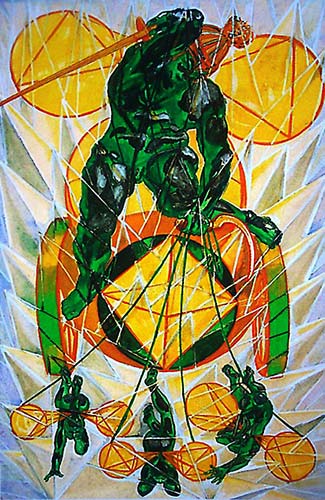
Hopes and Fears shows the expectations you have concerning the outcome of your question.
Prince of Swords
Aquarius
This card represents the airy part of Air. This chariot is drawn by winged children, looking and leaping irresponsibly in any direction that takes their fancy; they are not reined, but perfectly Capricious. The chariot consequently is easy enough to move, but quite unable to progress in any definite direction except by accident. This is a perfect picture of the Mind.
The operation of his logical mental processes has reduced the Air, which is his element, to many diverse geometrical patterns, but in these there is no real plan; they are demonstrations of the powers of the Mind without definite purpose. In his right hand is a lifted sword wherewith to create, but in his left hand a sickle, so that what he creates he instantly destroys. A person thus symbolised is purely intellectual. He is full of ideas and designs which tumble over each other. He is a mass of fine ideals unrelated to practical effort. He has all the apparatus of Thought in the highest degree, intensely clever, admirably rational, but unstable of purpose, and in reality indifferent even to his own ideas, as knowing that any one of them is just as good as any other. He reduces everything to unreality by removing its substance and transmuting it to an ideal world of ratiocination which is purely formal and out of relation to any facts, even those upon which it is based.
The Outcome of your question. Interpret this card in the context of the entire reading and as an indicator of the path you are currently on, but not necessarily bound to.
The Sun
The Sun
Glory, gain, riches, triumph, pleasure, frankness, truth, shame-lessness, arrogance, vanity, manifestation, recovery from sickness, but sometimes sudden death.