
Game Plan Spread
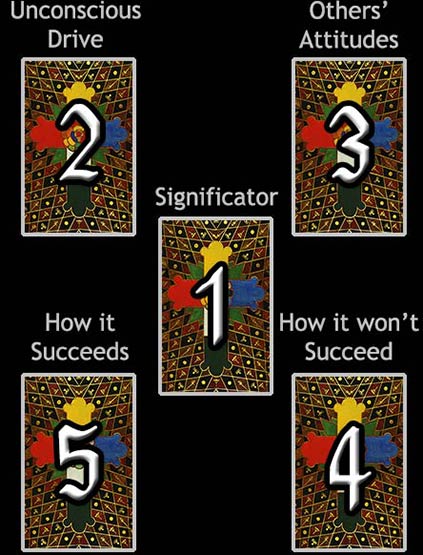
Difficulty: Easy
When a person has a certain plan in mind, this simple five-card spread presents a choice, hinting at what action or attitude should be taken for their plan to succeed, and what should be avoided to help the plan work out for the best.
The initial card is laid in the centre of the layout, the significator. The following four cards are laid out clockwise around the significator.
In this spread, the second card is about what drives the reader, but also says they are not fully conscious of this, perhaps even completely unaware of it. It provides a hint as to the reason they strive for their goal.
The third card uncovers what others think of the reader and their goals. The reader may or may not be aware of this. Sometimes other people factor into the plans (and sometimes they don't).
The fourth card suggests what not to do. If things are permitted to go down this path, the plan will collapse.
The fifth card is a hint as to how to make this plan work out favourably. The idea this card presents should be followed to make the plan successful. It is the differences between Cards #4 & #5 that should be noted, as the differences provide important clues.
Your Game Plan Tarot Reading with the Book of Thoth
Unconscious Drive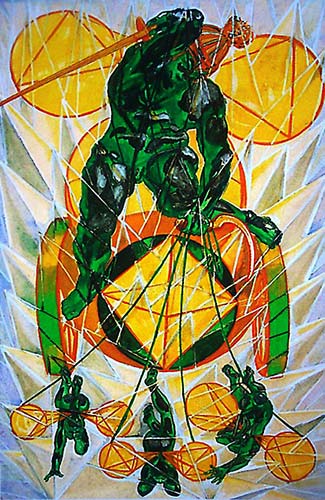 Prince of Swords |
External Influences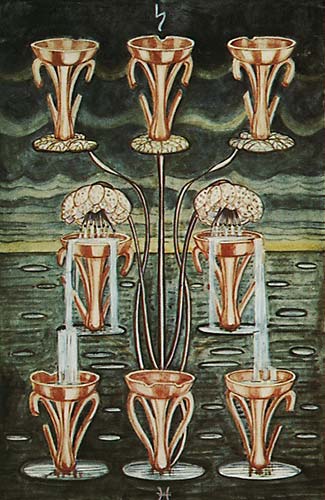 8 of Cups |
|
Significator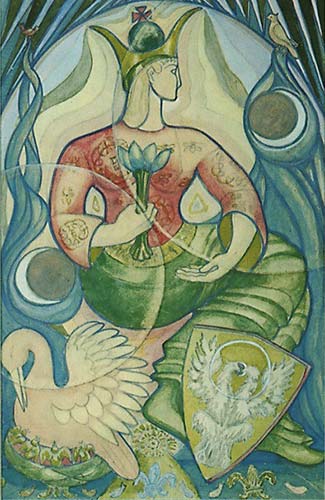 The Empress |
||
How it Will Succeed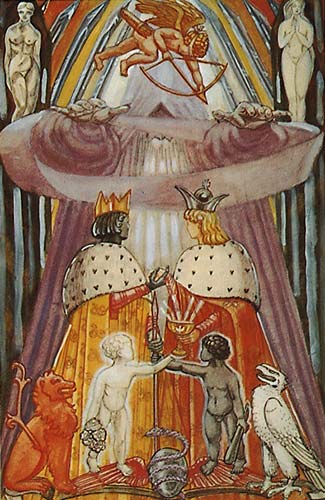 The Lovers |
How it Will Not Succeed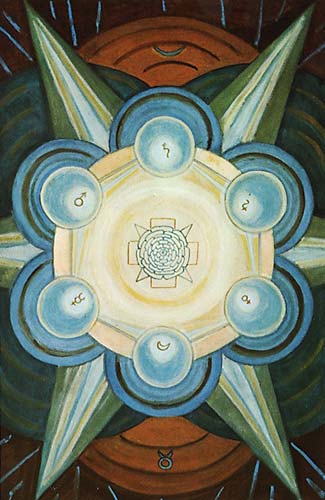 6 of Disks |
The Empress
Venus
Love, beauty, happiness, pleasure, success, completion, good fortune, graciousness, elegance, luxury, idleness, dissipation debauchery, friendship, gentleness, delight.
Prince of Swords
Aquarius
This card represents the airy part of Air. This chariot is drawn by winged children, looking and leaping irresponsibly in any direction that takes their fancy; they are not reined, but perfectly Capricious. The chariot consequently is easy enough to move, but quite unable to progress in any definite direction except by accident. This is a perfect picture of the Mind.
The operation of his logical mental processes has reduced the Air, which is his element, to many diverse geometrical patterns, but in these there is no real plan; they are demonstrations of the powers of the Mind without definite purpose. In his right hand is a lifted sword wherewith to create, but in his left hand a sickle, so that what he creates he instantly destroys. A person thus symbolised is purely intellectual. He is full of ideas and designs which tumble over each other. He is a mass of fine ideals unrelated to practical effort. He has all the apparatus of Thought in the highest degree, intensely clever, admirably rational, but unstable of purpose, and in reality indifferent even to his own ideas, as knowing that any one of them is just as good as any other. He reduces everything to unreality by removing its substance and transmuting it to an ideal world of ratiocination which is purely formal and out of relation to any facts, even those upon which it is based.
8 of Cups
Saturn in Pisces – Indolence
Lotuses droop for lack of sun and rain, and the soil is poison to them; only two of the stems show blossoms at all. The cups are shallow, old and broken. They are arranged in three rows; of these the upper row of three is quite empty. Water trickles from the two flowers into the two central cups, and they drip into the two lowest without filling them. The background of the card shows pools, or lagoons, in very extensive country, incapable of cultivation; only disease and miasma tic poison can flourish in those vast Bad Lands. The water is dark and muddy. On the horizon is a pallid, yellowish light, weighed down by leaden clouds of indigo.
6 of Disks
Moon in Taurus – Success
The Number Six, Tiphareth, as before, represents the full harmonious establishment of the Energy of the Element. The Moon in Taurus rules the card; and this, while increasing the approach to perfection (for the Moon is exalted in Taurus and therefore in her highest form) marks that the condition is transient.
The disks are arranged in the form of the Hexagram, which is shown in skeleton. In the centre blushes and glows the light rose- madder of dawn, and without are three concentric circles, golden yellow, salmon-pink, and amber. These colours show Tiphareth fully realised on Earth; it reaffirms in form what was mathematically set forth in describing the Ace. The planets are arranged in accordance with their usual attribution; but they are only shown as disks irradiated by the Sun in their centre. This Sun is idolised as the Rose and Cross; the Rose has forty-nine petals, the interplay of the Seven with the Seven.
The Lovers
Gemini
Openness to inspiration, intuition, intelligence, second sight, childishness, frivolity, thoughtfulness divorced from practical consideration, indecision, self-contradiction, union in a shallow degree with others, instability, contradiction, triviality, the 'high-brow'.