Horse Shoe Spread
Difficulty: Easy
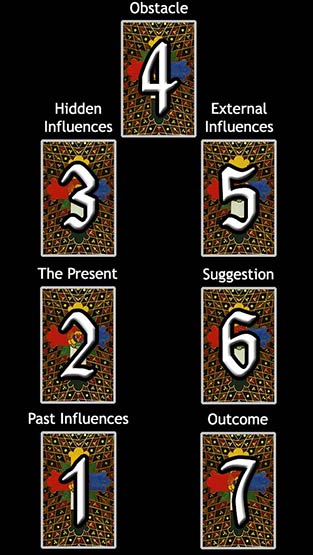
The Horse Shoe is a classic tarot spread. It is more advanced than the three-card reading, yet simpler than most other spreads. It is a versatile method that can be used for most queries, though there are other spreads which would go into more depth. Like the simple Past, Present, and Future spread, it contains these cards in positions #1, #2, and #7, but also has four other tarot cards that help the reader understand how to deal with the future better. The cards are to be read as follows:
- The Past: Past events affecting the question.
- The Present: The current state or approaching influence.
- Hidden Influences: Things the reader may not be aware of (or barely be aware of).
- Obstacles: This is the challenge: obstacles may be avoided or may have to be dealt with.
- External Influences: Attitudes and thoughts regarding people around the reader.
- Suggestions: Recommended course of action.
- Outcome: The result of following the suggestions.
Your Horse Shoe Tarot Reading with the Book of Thoth
Obstacle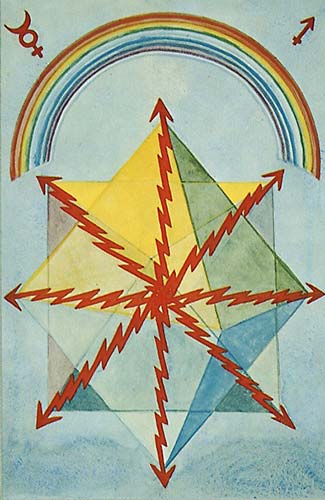 8 of Wands |
||
Hidden Influences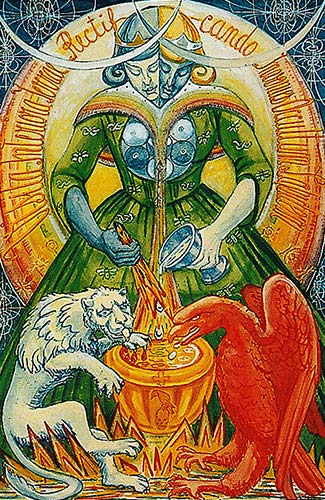 Art |
External Influences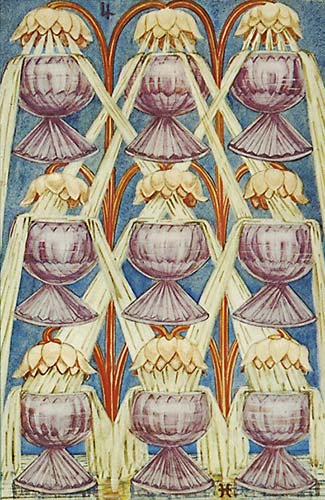 9 of Cups |
|
The Present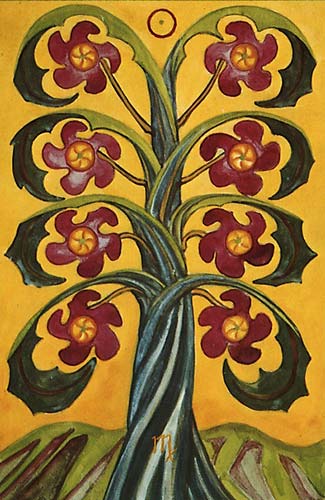 8 of Disks |
Suggestion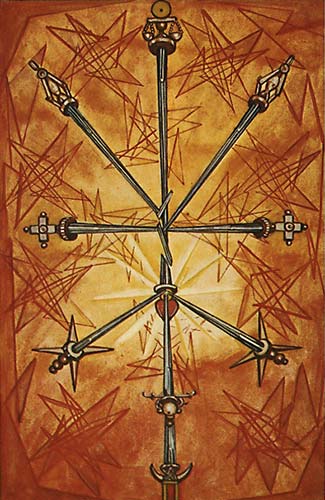 10 of Swords |
|
The Past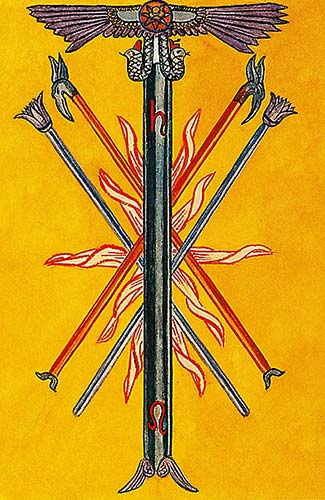 5 of Wands |
The Outcome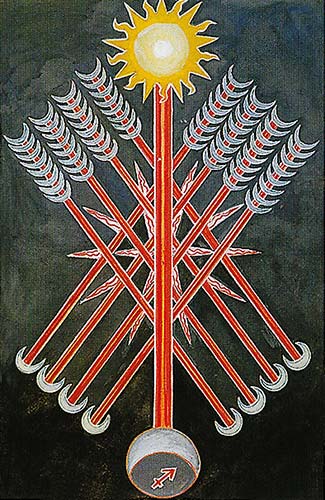 9 of Wands |
The Past represents past events that are affecting the question.
5 of Wands
Saturn in Leo – Strife
This card is referred to Geburah of the suit of Fire. Geburah itself being fiery, it is a purely active force. It is ruled also by Saturn and Leo. Leo shows the element of Fire at its strongest and most balanced. Saturn tends to weigh it down and to embitter it. There is no limit to the scope of this volcanic energy.
The symbol represents the wand of the Chief Adept, showing that the authority is derived from the superiors; were it not so, this card would be thoroughly disastrous. Moreover, there are also two wands of the Second, or Major Adept. They have the head of the Phoenix, which gives the idea of destruction (or rather purgation) through fire, and the resurrection of the energy from its ashes.
The Present represents the current state or immediately approaching influence.
8 of Disks
Sun in Virgo – Prudence
The number Eight, Hod, is very helpful in this card, because it represents Mercury in his most spiritual aspect, and he both rules and is exalted in the sign of Virgo, which belongs to the Decan, and is governed by the Sun. It signifies intelligence lovingly applied to material matters, especially those of the agriculturalist, the artificer and the engineer.
One might suggest that this card marks the turn of the tide. The seven of Disks is in one sense the fullest possible establishment of Matter – compare Atu XV – the lowest fallen and therefore the highest exalted. These last three cards seem to prepare the explosion which will renew the whole Cycle. Note that Virgo is Yod, the secret seed of Life, and also the Virgin Earth awaiting the Phallic Plough.
The interest of this card is the interest of the common people. The rulership of the Sun in Virgo suggests also birth. The disks are arranged in the form of the geomantic figure Populus. These disks may be represented as the flowers or fruits of a great tree, its solid roots in fertile land.
Hidden Influences - Things that you may not be aware of, or barely be aware of.
Art
Sagittarius
Combination of forces, realisation, action based on accurate calculation; the way of escape, success after elaborate manoeuvres.
Obstacle - This is the challenge.
8 of Wands
Mercury in Sagittarius – Swiftness
The card refers to Hod, splendour, in the suit of Fire, whence it refers to the phenomena of speech, light, electricity. The pictorial representation of the card shows the Light-wands turned into electrical rays, sustaining or even constituting Matter by their vibrating energy. Above this restored universe shines the rainbow; the division of pure light, which deals with maxima, into the seven colours of the spectrum, which exhibit interplay and correlation.
This card, therefore, represents energy of high velocity, such as furnishes the master-key to modern mathematical physics.
External Influences - Attitudes about this situation from people around the querent.
9 of Cups
Jupiter in Pisces – Happiness
The Number Nine, Yesod, in the suit of Water, restores the stability lost by the excursions of Netzach and Hod from the Middle Pillar. It is also the number of the Moon, thus strengthening the idea of Water.
In this card is the pageant of the culmination and perfection of the original force of Water. In the symbol are nine cups perfectly arranged in a square; all are filled and overflowing with Water. It is the most complete and most beneficent aspect of the force of Water.
Suggestion - The recommended course of action.
10 of Swords
Sun in Gemini – Ruin
The number Ten, Malkuth, as always, represents the culmination of the unmitigated energy of the idea. It shows reason run mad, ramshackle riot of soulless mechanism; it represents the logic of lunatics and (for the most part) of philosophers. It is reason divorced from reality.
The card is also ruled by the Sun in Gemini, but the mercurial airy quality of the Sign serves to disperse his rays; this card shows the disruption and disorder of harmonious and stable energy.
The hilts of the Swords occupy the positions of the Sephiroth, but the points One to Five and Seven to Nine touch and shatter the central Sword (six) which represents the Sun, the Heart, the child of Chokmah and Binah. The tenth Sword is also in splinters. It is the ruin of the Intellect, and even of all mental and moral qualities.
The Outcome - What will happen if the suggestion is followed.
9 of Wands
Moon in Sagittarius – Strength
This card is referred to Yesod, the Foundation; this brings the Energy back into balance. The Nine represents always the fullest development of the Force in its relation with the Forces above it. The Nine may be considered as the best that can be obtained from the type involved, regarded from a practical and material standpoint. This card is also governed by the Moon in Sagittarius; so here is a double influence of the Moon on the Tree of Life. Hence the aphorism 'Change is Stability'.
The Wands have now become arrows. There are eight of them in the background, and in front of them one master arrow. This has the Moon for its point, and the Sun for the driving Force above it; for the path of Sagittarius on the Tree of Life joins the Sun and Moon. The flames in the card are tenfold, implying that the Energy is directed downwards.