Path Spread
Difficulty: Easy
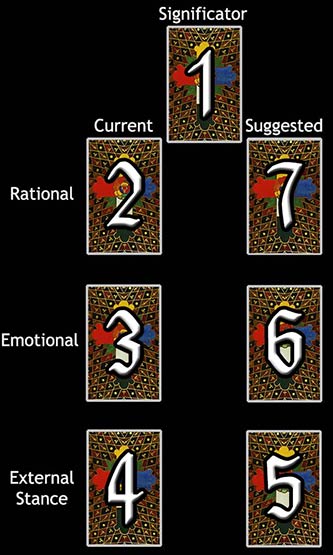
For the Path reading, one asks for suggestions how to behave properly to achieve a desired result. The Current column represents how the reader has been acting, and the Suggestedcolumn suggests how they should act to achieve a certain goal. The chart-like spread uses the standard three levels: Rational, Emotional, and External Stance (how one projects oneself outwardly). When comparing the Current and Suggested cards, the most important thing is to notice the differences between the two cards. It is these differences which hint at the behaviours that should be altered.
Card #1 is the significator, the card which should reflect the nature of the query and/or the desired outcome.
Card #2 shows the way the reader is and has been thinking. Card #7 suggests how to change the way one thinks to serve themselves better.
Card #3 suggests the reader's emotional attitude. Though it may seem difficult to manipulate one's own emotions, it can be done if one puts their mind to it. For example, acting a certain way such as smiling intently for a few minutes will lead the emotions to follow. When a person tries this, as silly as the exercise seems, they find this to evoke the emotion of happiness. For this reading, one should try to make themselves feel the way that Card #6 suggests.
External Stance means how one acts outwardly, how they hope others see them. Card #4 is about how the reader has been acting, while #5 indicates how they should act outwardly, for other people's sake. It is the differences between these cards that hint at what behaviour patterns should be altered.
Your Path Tarot Reading with the Book of Thoth
Current |
The Significator 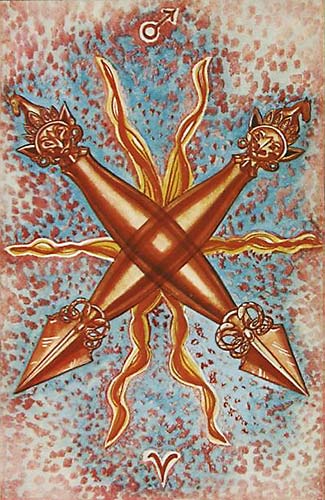 2 of Wands |
Suggested |
|
Thought |
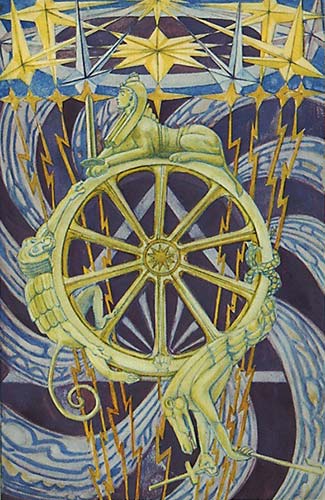 Fortune |
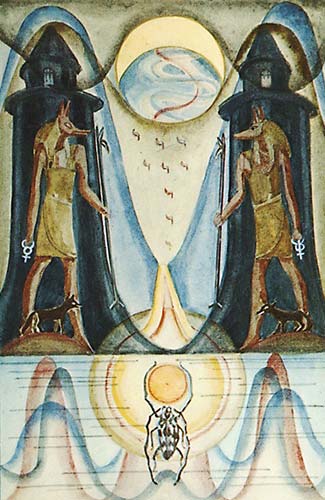 The Moon |
|
Emotion |
 Lust |
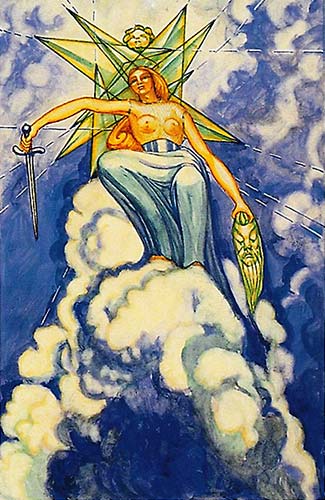 Queen of Swords |
|
External Stance |
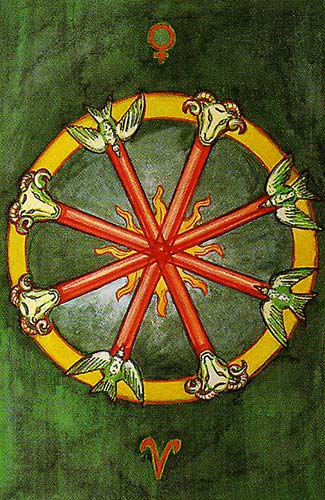 4 of Wands |
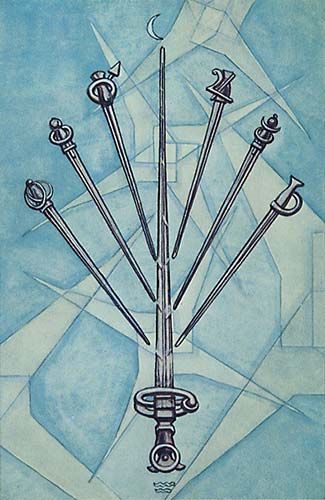 7 of Swords |
The Significator
2 of Wands
Mars in Aries – Dominion
This card, pertaining to Chokmah in the suit of Fire, represents the Will in its most exalted form. It is an ideal Will, independent of any given object.
'For pure will, unassuaged of purpose, delivered from the lust of result, is every way perfect'. AL. 1. 44.
The background of this card shows the power of the planet Mars in his own sign Aries, the first of the Signs. It there represents Energy initiating a Current of Force. The pictorial representation is two Dorjes crossed. The Dorje is the Tibetan symbol of the thunderbolt, the emblem of celestial Power, but more in its destructive than its creative form. More, that is, in its earlier rather than its later form. For destruction may be regarded as the first step in the creative process. The virgin ovum must be broken in order to fertilise it. Fear and repulsion are therefore the primary reaction to the assault. Then, with understanding of the complete plan, willing surrender rejoices to co-operate. Six flames issue from the centre. This indicates the influence of the Sun, who is exalted in Aries. This is the creative Will.
Current Thoughts
Fortune
Jupiter
Change of fortune. (This generally means good fortune because the fact of consultation implies anxiety or discontent.)
Suggested Thoughts
The Moon
Pisces
Illusion, deception, bewilderment, hysteria, even madness, dreaminess, falsehood, error, crisis, 'the darkest hour before the dawn', the brink of important change.
Current Emotions
Lust
Leo
Courage, strength, energy and action, une grande passion; resort to magick, the use of magical power.
Suggested Emotions
Queen of Swords
Libra
The Queen of Swords represents the watery part of Air, the elasticity of that element, and its power of transmission. She is enthroned upon the clouds. Her helmet is crested by the head of a child, and from it stream sharp rays of light, illuminating her empire of celestial dew. In her right hand, she bears a sword; in her left hand, the newly severed head of a bearded man. She is the clear, conscious perception of Idea, the Liberator of the Mind.
The person symbolised by this card should be intensely perceptive, a keen observer, a subtle interpreter, an intense individualist, swift and accurate at recording ideas; in action confident, in spirit gracious and just. Her movements will be graceful, and her ability in dancing and balancing exceptional. If ill-dignified, these qualities will all be turned to unworthy purposes. She will be cruel, sly, deceitful and unreliable; in this way, very dangerous, on account of the superficial beauty and attractiveness which distinguish her.
Current External Stance
4 of Wands
Venus in Aries – Completion
This card refers to Chesed in the suit of Fire. Being below the Abyss, it is the Lord of all manifested active Power. The original Will of the Two has been transmitted through the Three, and is now built up into a solid system: Order, Law, Government. It is also referred to Venus in Aries, which indicates that one cannot establish one's work without tact and gentleness. The wands are headed by the Ram, sacred to Chesed, the Father-god Amoun-Ra, as also to Aries; but at the other end of the wands are the Doves of Venus.
In the symbol, the ends of the wands touch a circle, showing the completion and limitation of the original work. It is within this circle that the flames (four double, as if to assert the balance) of the Energy are seen to play, and there is no intention to increase the scope of the original Will.
Suggested External Stance
7 of Swords
Moon in Aquarius – Futility
Netzach, in the suit of Swords, does not represent such catastrophe as in the other suits, for Netzach, the Sephira of Venus, means victory. There is, therefore, a modifying influence; and this is accentuated by the celestial rule of the Moon in Aquarius.
The intellectual wreckage of the card is thus not so vehement as in the Five. There is vacillation, a wish to compromise, a certain toleration. But, in certain circumstances, the results may be more disastrous than ever. This naturally depends upon the success of the policy. This is always in doubt as long as there exist violent, uncompromising forces which take it as a natural prey. This card, like the Four, suggests the policy of appeasement.
The symbol shows six Swords with their hilts in crescent formation. Their points meet below the centre of the card, impinging upon a blade of a much larger up-thrusting sword, as if there were a contest between the many feeble and the one strong. He strives in vain.