The Three Pyramids Spread
Difficulty: Complicated
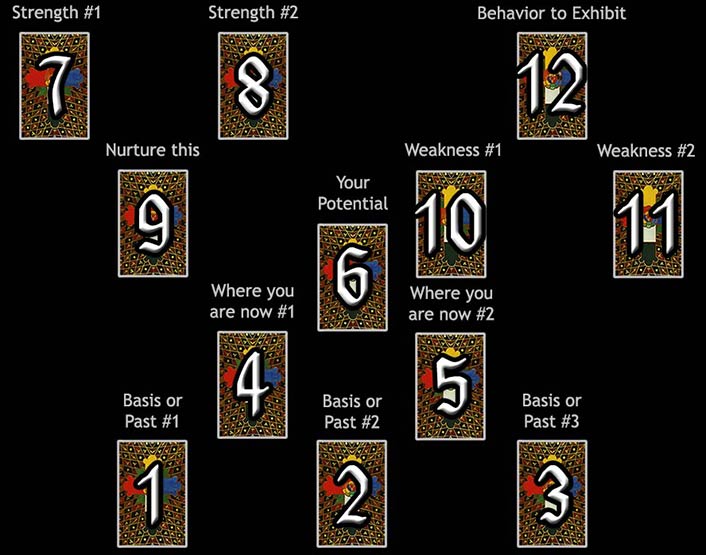
Basically, there is the main pyramid in the centre, and two smaller pyramids on each side. One is inverted.
Positions 1 & 3 represent where the reader comes from, or what has made them/shaped them on the various levels. Can be from environment, upbringing, schooling, etc. A look at the past, but with more objectivity than is usually given when using tarot cards.
Positions 4 & 5 represent who the reader is right now. May or may not make pleasant reading, but hey, this is what this is about, right?
Position 6 represents who the reader could be. Again, it might or might not look good, but a person can learn from that and change who they are accordingly. (This is a bit like how Scrooge did things in 'A Christmas Carol'.)
Positions 7 & 8 are the reader's strengths. This is the light they have, which can be bought to the forefront. What carries the person should not be hidden or unacknowledged.
Position 9 represents what should be given to oneself or created within.
Position 10 & 11 represent personal areas for development or weaknesses. Again, might not make good reading, but if someone looks at their strengths first, they will be able to see a balance is there and can choose to focus on one side or the other. This is where a person could really see how their shadow side comes into play.
Position 12 represents what the reader should be offering externally, or what they can bring to their world or to others who inhabit that world.
Your Three Pyramids Tarot Reading with the Book of Thoth
Strength #1 |
Strength #2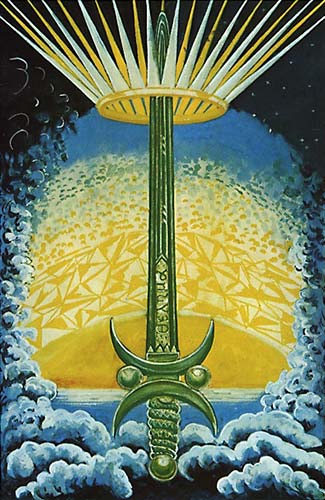 |
 |
Exhibit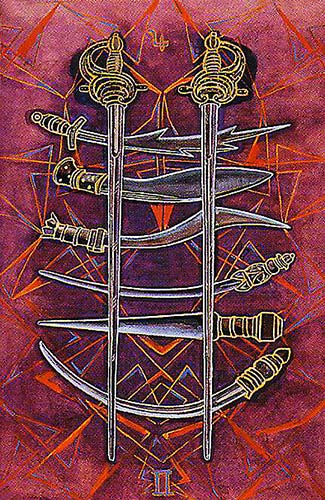 |
|||
Nurture This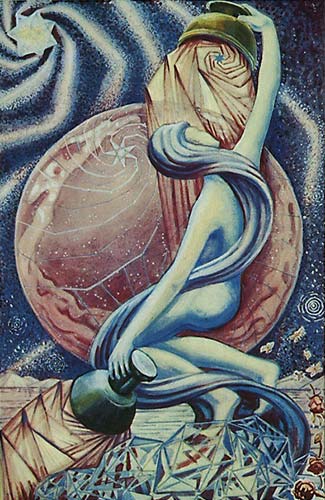 |
Potential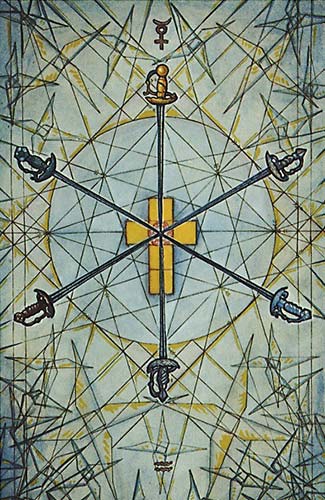 |
Infirmity #1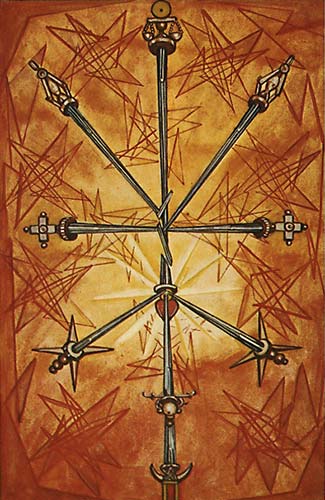 |
Infirmity #2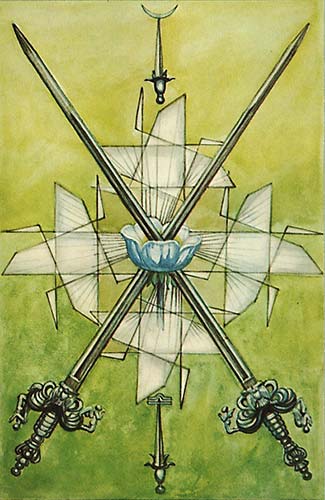 |
|||
Now #1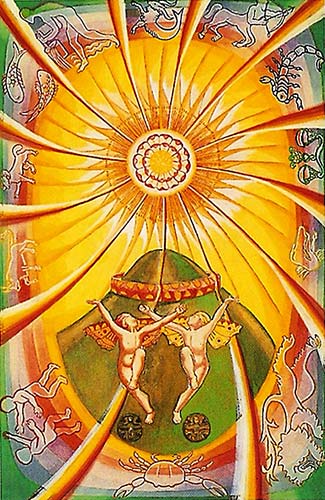 |
Now #2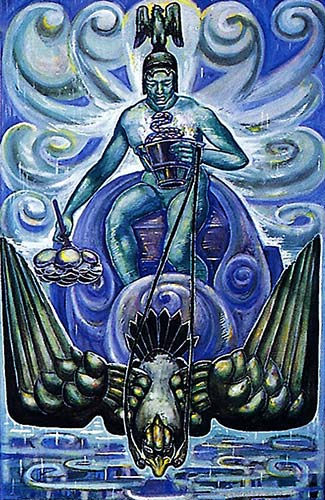 |
|||||
Base (past) #1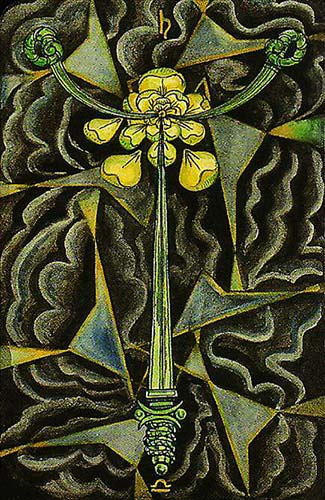 |
Base (past) #2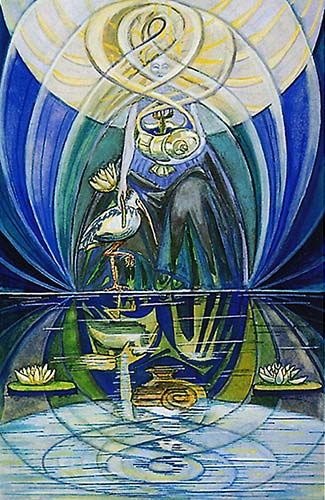 |
Base (past) #3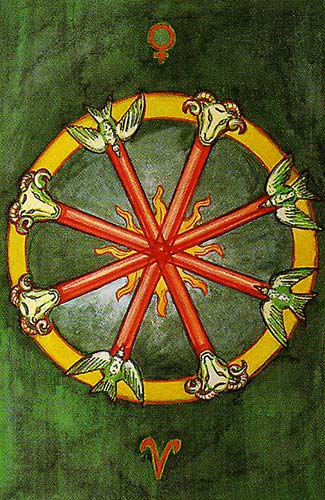 |
1: Base #1
Saturn in Libra – Sorrow
This card is dark and heavy; it is, so to speak, the womb of Chaos. There is an intense lurking passion to create, but its children are monsters. This may mean the supreme transcendence of the natural order. Secrecy is here, and Perversion.
The symbol represents the great Sword of the Magician, point uppermost; it cuts the junction of two short curved swords. The impact has destroyed the rose. In the background, storm broods under implacable night.
2: Base #2
Cancer
The Queen of Cups represents the watery part of Water, its power of reception and reflection. She reflects the nature of the observer in great perfection. She is represented as enthroned upon still water. In her hand she bears a shell-like cup, from which issues a crayfish, and she bears also the Lotus of Isis, of the Great Mother. She is robed in, and veiled by, endless curves of light, and the sea upon which she is enthroned conveys the almost unbroken images of the image which she represents.
The characteristics associated with this card are principally dreaminess, illusion and tranquillity. She is the perfect agent and patient, able to receive and transmit everything without herself being affected thereby. If ill-dignified, all these qualities are degraded. Everything that passes through her is refracted and distorted. But, speaking generally, her characteristics depend mostly upon the influences which affect her.
3: Base #3
Venus in Aries – Completion
This card refers to Chesed in the suit of Fire. Being below the Abyss, it is the Lord of all manifested active Power. The original Will of the Two has been transmitted through the Three, and is now built up into a solid system: Order, Law, Government. It is also referred to Venus in Aries, which indicates that one cannot establish one's work without tact and gentleness. The wands are headed by the Ram, sacred to Chesed, the Father-god Amoun-Ra, as also to Aries; but at the other end of the wands are the Doves of Venus.
In the symbol, the ends of the wands touch a circle, showing the completion and limitation of the original work. It is within this circle that the flames (four double, as if to assert the balance) of the Energy are seen to play, and there is no intention to increase the scope of the original Will.
4: Where you are now #1
The Sun
Glory, gain, riches, triumph, pleasure, frankness, truth, shame-lessness, arrogance, vanity, manifestation, recovery from sickness, but sometimes sudden death.
5: Where you are now #2
Scorpio
The Prince of Cups represents the airy part of Water. On the one hand, elasticity, volatility, hydrostatic equilibrium; on the other hand, the catalytic faculty and the energy of steam. He is a warrior partly clad in armour, which seems, however, rather a growth than a covering. His helmet is surmounted by an eagle, and his chariot, which resembles a shell, is also drawn by an eagle. His wings are tenuous, almost of gas. This is a reference to his power of volatilisation understood in the spiritual sense. The whole symbolism of this card is exceedingly complicated, for Scorpio is the most mysterious of the Signs, and the manifested portion of it symbolised by the eagle is in reality the least important part of his nature.
The moral characteristics of the person pictured in this card are subtlety, secret violence, and craft. He is intensely secret, an artist in all his ways. On the surface he appears calm and imperturbable, but this is a mask of the most intense passion. He is on the surface susceptible to external influences, but he accepts them only to transmute them to the advantage of his secret designs. He is thus completely without conscience in the ordinary sense of the word, and is therefore usually distrusted by his neighbours. They feel they do not, and can never, understand him. Thus, he inspires unreasonable fear. He is in fact perfectly ruthless. He cares intensely for power, wisdom, and his own aims.
6: Your potential
Mercury in Aquarius – Science
Tiphareth shows the full establishment and balance of the idea of the suit. This is particularly the case with this card, as the intellect itself is also referred to the number Six. Mercury, in Aquarius, represents the celestial Energy influencing the Kerub of the Man, thus showing intelligence and humanity.
But there is much more than this in the symbol. The perfect balance of all mental and moral faculties, hardly won, and almost impossible to hold in an ever-changing world, declares the idea of Science in its fullest interpretation.
The hilts of the Swords, which are very ornamental, are in the form of the hexagram. Their points touch the outer petals of a red rose upon a golden cross of six squares, thus showing the Rosy Cross as the central secret of scientific truth.
7: Strength #1
Virgo
The Knight of Disks represents the fiery part of Earth, and refers in particular to the phenomena of mountains, earthquakes, and gravitation; but it also represents the activity of Earth regarded as the producer of Life. This warrior is short and sturdy in type. He rides through the fertile land; even the distant hills are cultivated fields.
Those whom he symbolises tend to be dull, heavy and pre-occupied with material things. They are laborious and patient, but would have little intellectual grasp even of matters which concern them most closely. Their success in these is due to instinct, to imitation of Nature. They lack initiative; their fire is the smouldering fire of the process of growth.
8: Strength #2
The Root of Air
The Ace of Swords is the primordial Energy of Air, the Essence of the Vau of Tetragrammaton, the integration of the Ruach. Air is the result of the conjunction of Fire and Water; thus, it lacks the purity of its superiors in the male hierarchy, Fire, Sol and the Phallus. But for this same reason it is the first card directly to be apprehended by the normal consciousness of Mankind.
In nature, the obvious symbol of Air is the Wind 'which bloweth whithersoever it listeth'. It lacks the concentrated Will of Fire to unite with Water: it has no corresponding passion for its Twin Element, Earth. There is indeed, a notable passivity in its nature; evidently, it has no self-generated impulse. But, set in motion by its Father and Mother, its power is manifestly terrific. It visibly attacks its objective, as they, being of subtler and more tenuous character, can never do. Its 'all-embracing, all-wandering, all-penetrating, all-consuming' qualities have been described by many admirable writers, and its analogies are for the most part patent to quite ordinary observers.
9: Nurture this
Aquarius
Hope, unexpected help, clearness of vision, realisation of possibilities, spiritual insight, with bad aspects, error of judgment, dreaminess, disappointment.
10: Weakness #1
Sun in Gemini – Ruin
The number Ten, Malkuth, as always, represents the culmination of the unmitigated energy of the idea. It shows reason run mad, ramshackle riot of soulless mechanism; it represents the logic of lunatics and (for the most part) of philosophers. It is reason divorced from reality.
The card is also ruled by the Sun in Gemini, but the mercurial airy quality of the Sign serves to disperse his rays; this card shows the disruption and disorder of harmonious and stable energy.
The hilts of the Swords occupy the positions of the Sephiroth, but the points One to Five and Seven to Nine touch and shatter the central Sword (six) which represents the Sun, the Heart, the child of Chokmah and Binah. The tenth Sword is also in splinters. It is the ruin of the Intellect, and even of all mental and moral qualities.
11: Weakness #2
Moon in Libra – Peace
The Moon is change, but Nature is peaceful; moreover, Libra represents balance; between them, they regulate the energy of the Swords.
In the card appear two swords crossed; they are united by a blue rose with five petals. This rose represents the influence of the Mother, whose harmonising influence compounds the latent antagonism native to the suit. The Rose emits white rays, producing a geometrical pattern that emphasises the equilibrium of the symbol.
12: Behavior to exhibit
Jupiter in Gemini – Interference
The number Eight, Hod, here signifies lack of persistence in matters of the intellect and of contest. Good fortune, however, attends even these weakened efforts, thanks to the influence of Jupiter in Gemini, ruling the Decan. Yet the Will is constantly thwarted by accidental interference.
The centre of the card is occupied by two long Swords pointed downward. These are crossed by six small swords, three on each side. They remind one of weapons peculiar to their countries or their cults; we see here the Kriss, the Kukri, the Scramasax, the Dagger, the Machete and the Yataghan.