
Relationship Spread #2
Difficulty: Easy
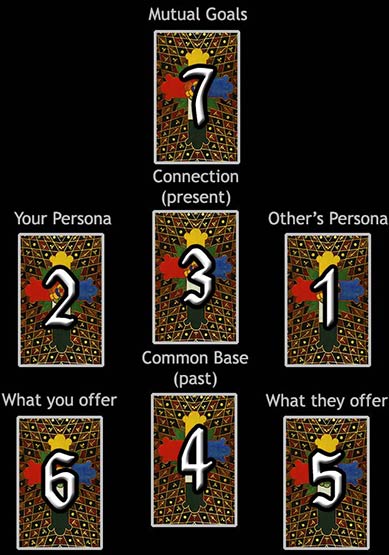
This relationship spread focuses more on the common ground of the relationship, with three cards in the middle column showing the common ground. The middle column essentially displays the past, present, and future of the relationship.
Card #4 stands for the common base of the relationship, which may be thought of as the past events which have shaped their characters, bringing them together. The current connection that binds them together is Card #3, indicating the values shared. Card #7 implies the common goals that would keep the pair together moving into the future.
The columns on either side show what each partner brings to the table. Remember, relationships need not be romantic, and the partners could even be groups rather than individuals. In this layout, the other person is on the left-hand side and the reader on the right.
Cards #1 & #2 indicate the separate personalities of each member of the relationship. These cards form a sort of bridge with the cards beneath them, #5 & #6, which show the qualities that each partner offers the other person, and thus to the relationship as a whole.
Your Relationship Reading #2 with the Book of Thoth
Mutual Goals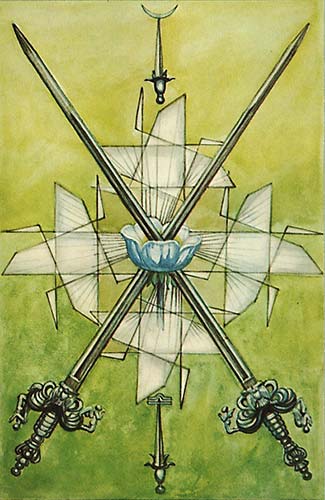 |
||
Your Qualities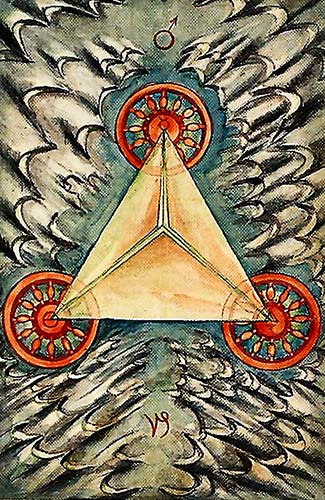 |
Connection (Present)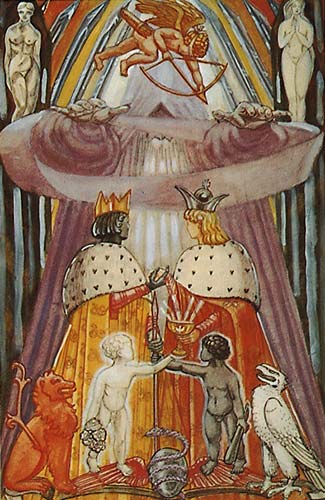 |
Others' Qualities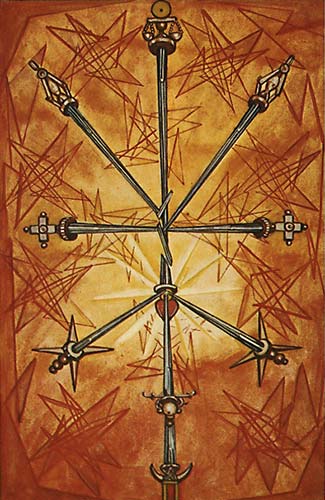 |
What You Bring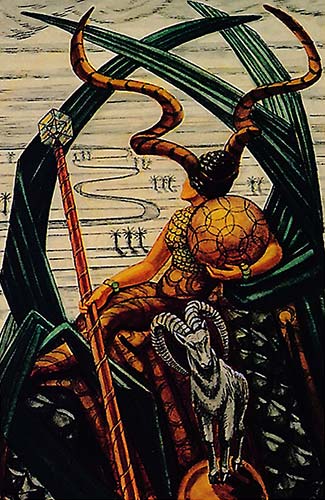 |
Common Base (Past) |
What They Bring 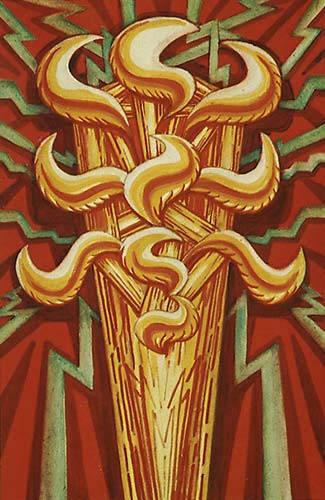 |
7: Mutual Goals
2 of Swords
Moon in Libra – Peace
The Moon is change, but Nature is peaceful; moreover, Libra represents balance; between them, they regulate the energy of the Swords.
In the card appear two swords crossed; they are united by a blue rose with five petals. This rose represents the influence of the Mother, whose harmonising influence compounds the latent antagonism native to the suit. The Rose emits white rays, producing a geometrical pattern that emphasises the equilibrium of the symbol.
3: Connection
The Lovers
Gemini
Openness to inspiration, intuition, intelligence, second sight, childishness, frivolity, thoughtfulness divorced from practical consideration, indecision, self-contradiction, union in a shallow degree with others, instability, contradiction, triviality, the 'high-brow'.
4: Common Base
The Magus
Mercury
Skill, wisdom, adroitness, elasticity, craft, cunning, deceit, theft. Sometimes occult wisdom or power, sometimes a quick impulse, a brain-wave. It may imply messages, business transactions, the interference of learning or intelligence with the matter in hand.
2: Your Qualities
3 of Disks
Mars in Capricorn – Works
The influence of Binah in the sphere of Earth shows the material establishment of the idea of the Universe, the determination of its basic form. It is ruled by Mars in Capricornus; he is exalted in that Sign, and therefore at his best. His energy is constructive, like that of the builder or engineer. The card represents a pyramid viewed from above the apex.
This pyramid is situated in the great Sea of Binah in the Night of Time, but the sea is solidified; hence the colours of the background are mottled, a cold thin dark grey with a pattern of indigo and green. The sides of the pyramid have a strong reddish tint, showing the influence of Mars.
1: Their Qualities
10 of Swords
Sun in Gemini – Ruin
The number Ten, Malkuth, as always, represents the culmination of the unmitigated energy of the idea. It shows reason run mad, ramshackle riot of soulless mechanism; it represents the logic of lunatics and (for the most part) of philosophers. It is reason divorced from reality.
The card is also ruled by the Sun in Gemini, but the mercurial airy quality of the Sign serves to disperse his rays; this card shows the disruption and disorder of harmonious and stable energy.
The hilts of the Swords occupy the positions of the Sephiroth, but the points One to Five and Seven to Nine touch and shatter the central Sword (six) which represents the Sun, the Heart, the child of Chokmah and Binah. The tenth Sword is also in splinters. It is the ruin of the Intellect, and even of all mental and moral qualities.
6: What You Bring
Queen of Disks
5: What They Bring
Ace of Wands
The Root of Fire
This card represents the essence of the element of Fire in its inception. It is a solar-phallic outburst of flame from which spring lightnings in every direction. These flames are Yods, arranged in the form of the Tree of Life.
It is the primordial Energy of the Divine manifesting in Matter, at so early a stage that it is not yet definitely formulated as Will.