
Single-Card Tarot Reading with the Book of Thoth (With the Option to Continue)
Difficulty: Easiest
The one card tarot reading is best for times when focusing on just one thing without any potential complications is desirable. It can be used for just about any question, including to draw a card of the day, week, or even one's card of ultimate destiny. It can also be used repetitively, as some readers prefer to pull one card at a time, watching as a story unfolds. There are even some readers who don't use tarot spreads at all, relying on this method alone.
Your One-Card (at a time) Reading
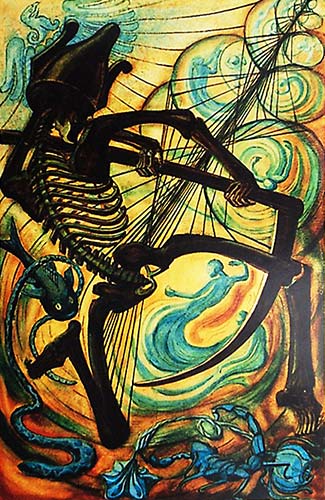
Draw #1 — Ace of Swords
The Root of Air
The Ace of Swords is the primordial Energy of Air, the Essence of the Vau of Tetragrammaton, the integration of the Ruach. Air is the result of the conjunction of Fire and Water; thus, it lacks the purity of its superiors in the male hierarchy, Fire, Sol and the Phallus. But for this same reason it is the first card directly to be apprehended by the normal consciousness of Mankind.
In nature, the obvious symbol of Air is the Wind 'which bloweth whithersoever it listeth'. It lacks the concentrated Will of Fire to unite with Water: it has no corresponding passion for its Twin Element, Earth. There is indeed, a notable passivity in its nature; evidently, it has no self-generated impulse. But, set in motion by its Father and Mother, its power is manifestly terrific. It visibly attacks its objective, as they, being of subtler and more tenuous character, can never do. Its 'all-embracing, all-wandering, all-penetrating, all-consuming' qualities have been described by many admirable writers, and its analogies are for the most part patent to quite ordinary observers.
The Ace of Swords is the primordial Energy of Air, the Essence of the Vau of Tetragrammaton, the integration of the Ruach. Air is the result of the conjunction of Fire and Water; thus, it lacks the purity of its superiors in the male hierarchy, Fire, Sol and the Phallus. But for this same reason it is the first card directly to be apprehended by the normal consciousness of Mankind.
In nature, the obvious symbol of Air is the Wind 'which bloweth whithersoever it listeth'. It lacks the concentrated Will of Fire to unite with Water: it has no corresponding passion for its Twin Element, Earth. There is indeed, a notable passivity in its nature; evidently, it has no self-generated impulse. But, set in motion by its Father and Mother, its power is manifestly terrific. It visibly attacks its objective, as they, being of subtler and more tenuous character, can never do. Its 'all-embracing, all-wandering, all-penetrating, all-consuming' qualities have been described by many admirable writers, and its analogies are for the most part patent to quite ordinary observers.