
Three-Card Spread
Difficulty: Very easy
This simplistic chronological spread can be used to shed light on the influences that have passed, current influences, and what is approaching in the near future. Not much explanation is necessary for this simple tarot spread.
Your Three-Card Tarot Reading with the Book of Thoth
The Past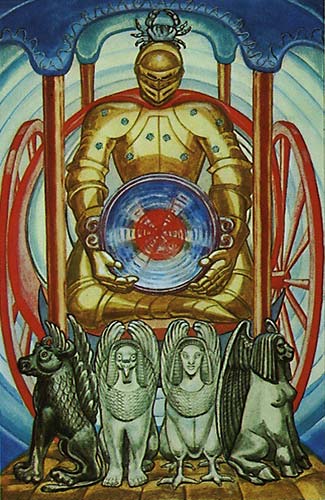 The Chariot |
The Present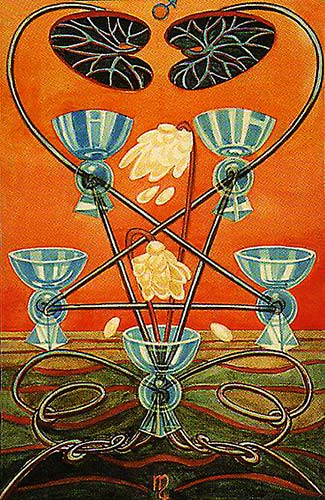 5 of Cups |
The Future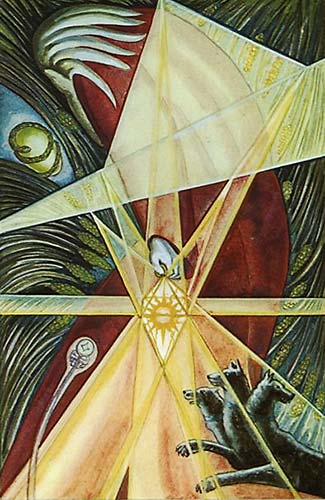 The Hermit |
The Past
The Chariot
Cancer
Triumph, victory, hope, memory, digestion, violence in maintaining traditional ideas, the 'die-hard', ruthlessness, lust of destruction, obedience, faithfulness, authority under authority.
The Present
5 of Cups
Mars in Scorpio – Disappointment
This card is ruled by Geburah in the suit of Water. Geburah being fiery, there is a natural antipathy. Hence arises the idea of disturbance, just when least expected, in a time of ease. The attribution is also to Mars in Scorpio, which is his own house; and Mars is the manifestation on the lowest plane of Geburah, while Scorpio, in its worst aspect, suggests the putrefying power of Water.
Yet the powerful male influences do not show actual decay, only the beginning of destruction; hence, the anticipated pleasure is frustrated. The Lotuses have their petals torn by fiery winds; the sea is arid and stagnant, a dead sea, like a 'chott' in North Africa. No water flows into the cups. Moreover, these cups are arranged in the form of an inverted pentagram, symbolising the triumph of matter over spirit.
The Future
The Hermit
Virgo
Illumination from within, secret impulse from within; practical plans derived accordingly. Retirement from participation in current events.