
Path Layout
Difficulty: Easy
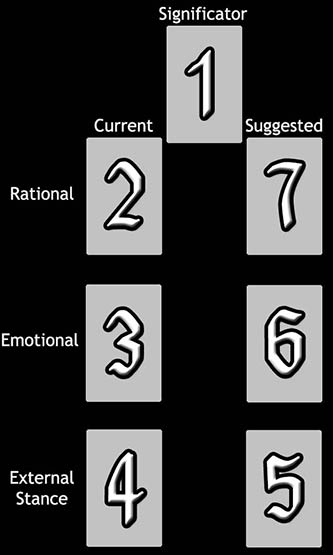
For the Path reading, one asks for suggestions how to behave properly to achieve a desired result. The Current column represents how the reader has been acting, and the Suggestedcolumn suggests how they should act to achieve a certain goal. The chart-like layout uses the standard three levels: Rational, Emotional, and External Stance (how one projects oneself outwardly). When comparing the Current and Suggested runes, the most important thing is to notice the differences between the two runes. It is these differences which hint at the behaviours that should be altered.
Rune #1 is the significator, the rune which should reflect the nature of the query and/or the desired outcome.
Rune #2 shows the way the reader is and has been thinking. Rune #7 suggests how to change the way one thinks to serve themselves better.
Rune #3 suggests the reader's emotional attitude. Though it may seem difficult to manipulate one's own emotions, it can be done if one puts their mind to it. For example, acting a certain way such as smiling intently for a few minutes will lead the emotions to follow. When a person tries this, as silly as the exercise seems, they find this to evoke the emotion of happiness. For this reading, one should try to make themselves feel the way that Rune #6 suggests.
External Stance means how one acts outwardly, how they hope others see them. Rune #4 is about how the reader has been acting, while #5 indicates how they should act outwardly, for other people's sake. It is the differences between these runes that hint at what behaviour patterns should be altered.
Your Path Reading
| Current | The Significator Dagaz |
Suggested | |
| Thought | 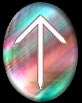 Tiwaz |
 Fehu |
|
| Emotion |  Thurisaz |
 Gebo |
|
| External Stance | 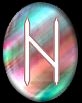 Hagalaz |
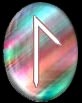 Laguz |
The Significator
Dagaz
Dagaz heralds the dawn of transformation and awakening, symbolising clarity, enlightenment, and the breakthrough from darkness into light. It indicates that a period of profound change is upon you—a time when obstacles melt away to reveal new possibilities. Dagaz promises renewed focus and the successful completion of long-standing challenges. In relationships, it fosters honest communication and the resolution of conflicts through clarity. Dagaz is the spark of enlightenment, urging you to embrace a higher state of consciousness and celebrate the clarity that comes from personal transformation. Reflect on the light emerging in your life and let it guide you towards a brighter, re-energised future.
Current Thoughts
Tiwaz
Tiwaz is the rune of honour, courage, and righteous action—a call to stand for justice and to act with integrity. It represents the disciplined warrior spirit willing to make sacrifices for the greater good. Tiwaz emphasises ethical decision-making and the valour to pursue what is right even when difficult. In relationships, it encourages honesty, accountability, and the courage to resolve conflicts fairly. Tiwaz is a guide towards inner strength and the pursuit of higher truth, reminding you that real power lies in ethical action. Reflect on your values and consider how bold, principled actions can create lasting change in your life.
Suggested Thoughts
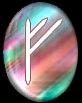
Fehu
Fehu embodies the abundant energy of creation and resourcefulness, symbolising not only material wealth but the power to manifest dreams. In readings, Fehu suggests you are entering a phase where your initiatives and investments—both financial and creative—can flourish if nurtured with generosity and practical wisdom. It may point to a lucrative opportunity or a breakthrough in your career. In relationships, it calls for sharing and mutual support. Fehu invites you to recognise the inherent richness of your inner world and to use your gifts for both personal growth and the benefit of others. Consider how you can balance ambition with altruism and remain open to the unexpected blessings that follow diligent effort.
Current Emotions
Thurisaz
Thurisaz is the rune of dynamic conflict and protective power—a force that can both wound and shield. Its energy warns of necessary confrontations or challenges that, when approached with wisdom, clear the path for transformation. In professional environments, Thurisaz may indicate obstacles requiring strategic courage or the assertion of personal boundaries. In relationships, it suggests that resolving conflicts honestly can lead to deeper trust. it symbolises the fire of purification, urging you to use adversity as a catalyst for inner growth and self-discovery. Consider how facing your fears and embracing necessary change can empower you to transcend limitations.
Suggested Emotions
Gebo
Gebo embodies the sacred art of exchange and the balanced giving and receiving that underpins healthy relationships and successful endeavours. This rune emphasises that true wealth comes from mutual support, cooperation, and the honest sharing of gifts—be they emotional, material, or spiritual. In the professional sphere, Gebo encourages partnerships built on trust and collaboration, while in personal relationships, it signifies reciprocity and the nurturing of bonds. Gebo reminds you that every act of generosity enriches your soul and the collective energy around you. Reflect on how you can cultivate balance and gratitude in your interactions.
Current External Stance
Hagalaz
Hagalaz is the emblem of disruptive natural forces and sudden change, representing the storms that clear away the old to make way for the new. This rune warns that while upheaval can be painful, it is often necessary for transformation. Hagalaz may indicate unexpected challenges or restructuring that, though initially disruptive, ultimately lead to growth. In relationships, it suggests that conflicts and crises can pave the way for renewed understanding. Hagalaz invites you to embrace life's impermanence and to find strength in chaos. Reflect on how adversity has shaped you and be open to the transformative power of disruption.
Suggested External Stance
Laguz
Laguz represents the fluid, transformative power of water—an emblem of intuition, emotion, and the subconscious. It urges you to trust your instincts and to let your emotions flow, as they hold vital clues to your inner truth. In practical matters, Laguz can signal the need for adaptability and emotional intelligence when navigating uncertainty. In relationships, it highlights the importance of empathy, healing, and nurturing connections with a gentle touch. Laguz invites you to dive deep into the hidden realms of your psyche, embracing both the clarity and mystery of your inner world. Reflect on how embracing your feelings can lead to insights and a richer, more authentic life.